
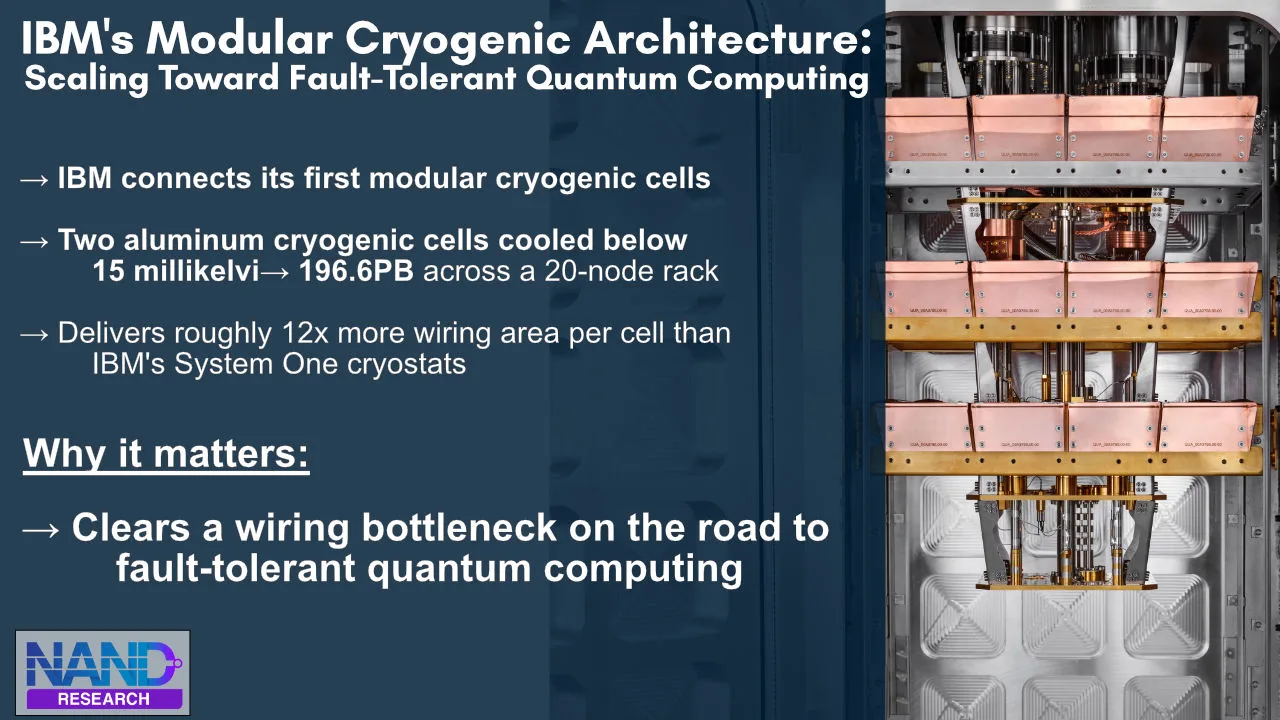
IBM has connected two modular cryogenic cells within a single cooled environment at its Poughkeepsie, New York, facility and cooled the combined system to below 15 millikelvin, more than 100 times colder than deep space. The demonstration replaces the cylindrical dilution-refrigerator enclosures used in IBM Quantum System One with box-shaped aluminum cells that sit side by side and link via short, shielded interconnect tunnels.
Each cell provides roughly 12 times as much usable wiring area as IBM’s existing System One cryostats. This additional area addresses a wiring-density constraint that has limited the number of qubits a single refrigeration environment can support.
This design addresses a specific engineering bottleneck in superconducting quantum computing: as processors add qubits, the control wiring required to operate them grows faster than the available space inside a cylindrical cryostat. IBM’s modular cells are designed to sit side by side, allowing wiring capacity and cooling volume to scale by adding units rather than requiring a single larger cryostat.
IBM ties the architecture to its published roadmap for IBM Quantum Starling, a fault-tolerant system targeted for 2029, and to an interim 2027 goal of using its L-coupler interconnect technology to link multiple processors into systems with at least 1,000 programmable qubits.
Technical Details
The core change concerns mechanical and thermal systems; it does not introduce a new qubit design. IBM’s existing cryostats are cylindrical dilution refrigerators, sourced in part from vendors such as Bluefors, and housed in towers that roughly resemble large tanks.
The new architecture replaces that enclosure with a box-shaped aluminum cell built from solid panels and framing. Each cell has its own vacuum chamber, cooling hardware, and layered thermal shielding.
Two cells sit next to each other, connected through openings in their walls. Multiple layers of Mylar superinsulation and progressively colder metal shields form a continuous, EMI-sealed cryogenic tunnel between them.
Each cell has roughly 2.75 cubic meters of vacuum-chamber volume, about three times the volume of a typical kitchen refrigerator, and measures more than eight feet tall and eight feet wide.
IBM provided the following specifications for the connected-cell demonstration:
- The base temperature across both connected cells was held below 15 millikelvin. IBM reported consistent cooldown behavior as cells were added.
- Each module cooled to 4 kelvins, the liquid-helium stage, in under five days.
- Each cell provides approximately 0.53 square meters of wiring area, which IBM says is about 12 times the area available in a System One cryostat.
- Metal EMI gaskets and rubber O-rings seal the module doors and are intended to block electromagnetic interference between the shared cryogenic environment and the outside.
- The cells support IBM’s L-coupler interconnects, superconducting aluminum cables up to one meter long that carry quantum information between chips in different cells. IBM demonstrated the underlying coupler technology in 2024.
Each cell is designed to hold at least 2,000 physical qubits, roughly equivalent to four quantum processing units. IBM expects a dozen or more connected modules to form the complete Starling system by 2029.
The next test will install Nighthawk 120-qubit processors in each of the two connected cells in late 2026, marking the architecture’s first operation with live qubits. The August milestone involved cooling and connecting the cells without processors.
The modular design also allows individual cells to be decoupled for shipping. Processors can be tested or replaced independently without returning the full cryostat to room temperature.
Analysis
The announcement aligns with IBM’s long-standing strategy of publishing a detailed multiyear quantum roadmap and reporting incremental progress toward named milestones. This public-accountability model, used since 2020, differentiates IBM from competitors that disclose roadmaps less frequently or with less technical detail.
Presenting a cryostat engineering demonstration as a milestone toward Starling keeps IBM’s superconducting-qubit approach visibly on schedule, even as trapped-ion and neutral-atom vendors make competing claims about near-term error correction and logical-qubit counts.
Competitive Impact
IBM’s modular cryostat addresses a challenge specific to superconducting qubits. IBM’s transmon qubits require dilution refrigeration to about 10-15 millikelvin, whereas trapped-ion and neutral-atom architectures operate at room temperature or in laser-cooled vacuum systems.
Among other superconducting-qubit vendors, Google and Rigetti face the same wiring-density and cryostat-scaling constraints that IBM is addressing. They have publicly emphasized different approaches.
- Google has focused on flip-chip packaging, which bonds a separate wiring-carrier chip to the qubit chip, moving routing off the qubit layer.
- Rigetti has described dilution refrigeration as a mature, commercially available technology and identified chiplet-based scaling as the binding constraint
| Alternative | Model / Approach | How It Compares to IBM’s Modular Cryostat |
| Google Quantum AI | Single large dilution refrigerator per system; scaling addressed primarily through flip-chip wiring packaging, with no published multi-module cryostat. | Addresses a similar wiring-density problem through chip packaging. Google has not published a modular, connectable cryostat design comparable to IBM’s cells. |
| Rigetti Computing | Standard commercial dilution refrigerators paired with chiplet-based multichip modules; cooling infrastructure is not identified as the scaling bottleneck. | Emphasizes gate speed and chiplet interconnects over cryostat engineering. IBM’s approach treats wiring density inside the cryostat as a constraint that Rigetti’s roadmap has yet to confront at IBM’s target qubit counts. |
| Quantinuum / IonQ (trapped-ion) | Ion traps held in ultrahigh-vacuum chambers with laser cooling; no millikelvin dilution refrigeration required. | Avoids the dilution-refrigerator scaling problem. Trapped-ion systems face other scaling limits, including gate speed and ion-shuttling complexity, so the approaches are not directly comparable on this metric. |
| D-Wave Quantum | Superconducting annealing architecture that also uses dilution refrigeration and is optimized for optimization workloads within a distinct computational model. | Shares IBM’s cryogenic-cooling requirement while targeting a different computational model, which limits direct comparison of hardware-scaling strategies. |
Final Thoughts
IBM has cleared a genuine engineering hurdle by connecting two independently cooled cryogenic cells within a shared, EMI-shielded environment below 15 millikelvin, with a wiring area meaningfully larger than that of its current production cryostat.
This capability is a necessary precondition for IBM’s multimodule systems on the roadmap. The company has clearly limited its claim to cooling and connectivity, excluding qubit operation at scale. That specificity supports the claim’s credibility.
Competitors pursuing superconducting qubits face the same wiring and cooling constraints that IBM is now addressing directly. Trapped-ion and neutral-atom vendors sidestep the dilution-refrigerator problem by relying on different physics. IBM’s cryostat innovation therefore solves a problem specific to its chosen qubit modality; it does not address a universal quantum-computing constraint.
For organizations tracking IBM’s path to fault-tolerant quantum computing, this milestone provides evidence that the component-level hardware engineering supporting IBM’s Starling timeline is progressing on schedule. It does not establish that IBM has operated a larger quantum processor.
The next two checkpoints will test the credibility of IBM’s 2029 target: operating live qubits in the connected cells and delivering a 1,000-qubit linked system in 2027. Both can now be measured against publicly announced deadlines.
Taken together, these advances reinforce IBM’s momentum toward fault-tolerant quantum computing. The company is translating its detailed public roadmap into measurable engineering progress across processors, interconnects, control systems, and cryogenic infrastructure.
The next milestones will present increasingly demanding tests of that strategy, but IBM’s ability to identify scaling constraints early and address them with concrete, testable solutions strengthens its standing as one of the industry’s most credible and technically ambitious quantum-computing leaders.