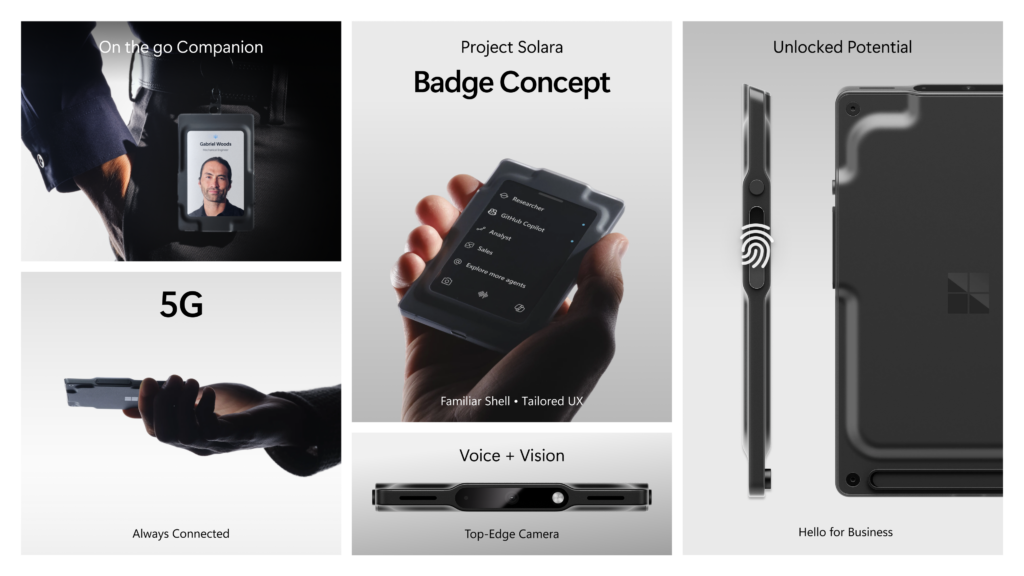
At its recent Build 2026 event, Microsoft introduced Project Solara, a chip-to-cloud platform built specifically for devices whose primary interface is an AI agent.
Solara runs on the Microsoft Device Ecosystem Platform (MDEP), a lightweight operating system built on AOSP that hosts an Agent Shell capable of dynamically loading and tailoring cloud-based agents, paired with a just-in-time UI framework that adapts the interface to the device, screen size, content, and interaction mode.
Microsoft demonstrated the platform on two reference designs, a wearable Badge concept and a Desk concept, using silicon from Qualcomm and MediaTek, enterprise management via Intune and Entra ID, and early pilots at Best Buy, CVS, Levi’s, and Target.
The announcement came days after Computex 2026, where Qualcomm CEO Cristiano Amon declared 2026 the Year of the Agent and described a future in which agentic workloads run continuously across phones, PCs, wearables, vehicles, robots, and cloud infrastructure, distributing token generation between the edge and the cloud for cost and efficiency.
Amon articulated the vision but left the control plane discussion unaddressed. Two days later, he shared the stage with Microsoft CEO Satya Nadella.
Microsoft’s Project Solara supplies the missing piece, providing a coherent operating plane that lets a single agent span low-power devices and the cloud under consistent identity, security, and management controls.
Project Solara is Microsoft’s bid to define that layer for the non-NVIDIA world (though it doesn’t explicitly exclude NVIDIA). If Microsoft succeeds, it raises the tide for the entire non-NVIDIA ecosystem, with Qualcomm, AMD, and MediaTek as immediate silicon beneficiaries and a longer list of OEMs, ISVs, and enterprises behind them.
Technical Details
Project Solara is a full chip-to-cloud platform whose central premise is that agentic workflows require purpose-built hardware tailored to how agents work (rather than how applications work), thereby lowering the cost and engineering effort of creating new device categories.
Historically, building a new form factor meant rebuilding much of the stack. Solara treats the agent as the universal interaction layer, so developers do not need to rearchitect for every screen size or modality. The platform comprises an operating system, an agent-hosting and presentation layer, and an enterprise management and security tier.
The core technical elements include:
- Microsoft Device Ecosystem Platform (MDEP): a lightweight, secure operating system built on AOSP, designed to be effectively invisible and to host agents.
- Agent Shell: a hosting layer within MDEP that dynamically loads and tailors multiple cloud-based agents, exposing them through an adaptive access layer that the user interacts with directly.
- Just-in-time UI: a framework in which the agent generates and adapts its own interface at runtime to the device, screen size, content, and interaction mode, spanning visual, voice, touch, and multimodal input.
- Enterprise management and identity: integration with Microsoft Intune for device management and with Entra ID for identity, addressing manageability, security, and privacy requirements for enterprise fleets.
- Reference hardware: a Badge concept resembling a small, pocketable touchscreen device with 5G connectivity and a camera, and a Desk concept comparable to an 8-inch smart display; both are reference designs, not commercial products.
- Silicon partners: Qualcomm and MediaTek are building the silicon for the initial agentic devices, and Microsoft states the platform will support a range of form factors and components.
Microsoft notes that the concept devices are already in use by hundreds of its employees and that the prototypes will serve as reference designs for partners to build turnkey solutions.
The company has not disclosed pricing, general availability timing, or the commercial licensing model for MDEP. The agent runtime’s dependence on cloud connectivity for full functionality is implied rather than fully specified.
Analysis
Project Solara extends Microsoft’s strategy of owning the operating environment for computing while remaining deliberately above the silicon. Notably, Solara is built on AOSP rather than Windows, showing that Microsoft prioritizes reach and a clean agent-first design over Windows continuity.
That choice echoes the lesson of Windows Phone, where a thin application catalog proved fatal; an agentic platform that does not depend on a large app ecosystem sidesteps that risk. Microsoft is betting that the operating plane, identity, and management layers are the durable points of control in the agentic era, not the device or the model.
It’s an approach that carries risk:
- Microsoft is introducing a new device category whose role relative to the PC and the smartphone remains undefined.
- The reliance on partner silicon and cloud agents means Microsoft controls the middle of the stack, but neither end,.
- The commercial model for MDEP is unproven.
The strength of its position rests on Microsoft’s enterprise management franchise and its relationships with Qualcomm and MediaTek (and other silicon providers), which are assets that few competitors can match.
Competitive Landscape
The agentic market is consolidating around two architectural poles:
- NVIDIA, with the Agent Toolkit unveiled at GTC 2026 and its Nemotron models, is positioning itself as the runtime, security, and data substrate beneath agents, extending CUDA-class lock-in into the agent layer and profiting whether model providers or SaaS incumbents win the tier above.
- The rest of the industry has articulated agentic visions but has lacked a common device-and-management plane to bind them.
Project Solara is Microsoft’s move to supply exactly that plane for the non-NVIDIA world, and its success would lift the broader ecosystem rather than Microsoft alone.
The table below summarizes how the major players relate to the agentic operating plane.
| Ecosystem / Player | Agentic Operating-Plane Position | Strengths & Gaps vs. Solara |
| NVIDIA | Agent Toolkit and Nemotron position NVIDIA as the runtime, security, and data substrate beneath agents, extending CUDA-class lock-in into the agent layer. | Owns the cloud and accelerated-compute base; weak in low-power client silicon and enterprise device management, which is where Solara concentrates. |
| Android, Gemini, and A2A give Google a device-to-cloud agent stack and a credible just-in-time-UI analog. | Strong consumer reach and model depth; weaker enterprise device-fleet management than Microsoft’s Intune and Entra position. | |
| Qualcomm | Snapdragon at the edge plus the new Dragonfly data-center brand articulate a hybrid edge-to-cloud agent vision but no operating plane to bind it. | Silicon partner to Solara rather than a competitor; benefits directly if Solara standardizes the non-NVIDIA device layer. |
| Apple | Tight silicon-to-OS integration and on-device inference, but a closed, consumer-centric model with no third-party device platform. | Best-in-class vertical integration; not addressable by enterprises wanting to build their own agent hardware. |
| Amazon / OpenAI / Salesforce | Each is building agentic platforms at the software and orchestration layer rather than a chip-to-cloud device operating environment. | Compete for the agent and orchestration tier; none offers Microsoft’s combined OS, silicon-partner, and management stack. |
Microsoft holds real differentiation in enterprise device management, identity, and its silicon-partner relationships, and in being first to extend the agent-first premise to purpose-built hardware that is neither a phone nor a PC.
It faces credible challenges:
- Google has a device-to-cloud agent stack in Android and Gemini
- Apple has unmatched vertical integration for consumer scenarios
- Amazon, OpenAI, and Salesforce are building strong agent and orchestration layers that could commoditize the tier above MDEP.
The sharpest competitive risk is that NVIDIA’s substrate becomes the default plumbing, even for non-NVIDIA devices, in which case Solara competes for the device and management layer while NVIDIA collects value beneath it.
Final Thoughts
Project Solara is the clearest articulation yet of Microsoft’s thesis that the next computing platform is organized around agents (not applications) and that durable value accrues in the operating environment, identity, and management layers.
By pairing MDEP and the Agent Shell with Intune, Entra, and silicon from Qualcomm and MediaTek, Microsoft has assembled a credible operating plane for the agentic vision Qualcomm described at Computex, even if Qualcomm did not supply it.
The two announcements are complementary: Qualcomm framed the demand for distributed, edge-to-cloud agentic workloads, while Microsoft is proposing the environment that makes those workloads coherent across devices.
The open questions are substantial. The hardware remains conceptual; the commercial model for MDEP remains unknown; the dependence on cloud-hosted agents raises governance and connectivity concerns; and the role of a new device class alongside PCs and phones remains unresolved.
Microsoft also has a mixed record of creating new categories, and willing this one into existence will require OEM, ISV, and enterprise commitment that a Build keynote cannot deliver on its own. The risk here is mitigated by the broader ecosystem’s willingness to engage.
The most important takeaway, however, is structural. As agentic infrastructure bifurcates into the NVIDIA ecosystem and everyone else, the non-NVIDIA world has lacked a unifying device-and-management layer. Project Solara is Microsoft’s bid to be that layer.
If it gains traction, it lifts the tide for the entire non-NVIDIA ecosystem, with Qualcomm and MediaTek as the first beneficiaries, followed by a broad field of OEMs, ISVs, and enterprises. That, more than any single concept device, is the reason Solara matters.