Today’s AI factories are gated by power, including how much a site can draw from the grid, how efficiently that power reaches a GPU, and how much useful compute each watt produces.
It’s a dynamic central to the recent news of NVIDIA‘s investment of up to $3 billion in Lancium, a Texas-based power infrastructure developer. That collaboration pairs NVIDIA’s strategic investment with the use of NVIDIA’s DSX across Lancium’s 4 GW of leased capacity and its 15+ GW development pipeline.
While the NVIDIA-Lancium announcement didn’t name infrastructure partners, it’s worth looking at the problem through the lens of the long-time collaboration between Siemens and NVIDIA, which pairs their respective strengths to jointly address the problem:
- Siemens contributes simulation-validated electrical, automation, and digital-twin infrastructure spanning the path from utility interconnection to the rack.
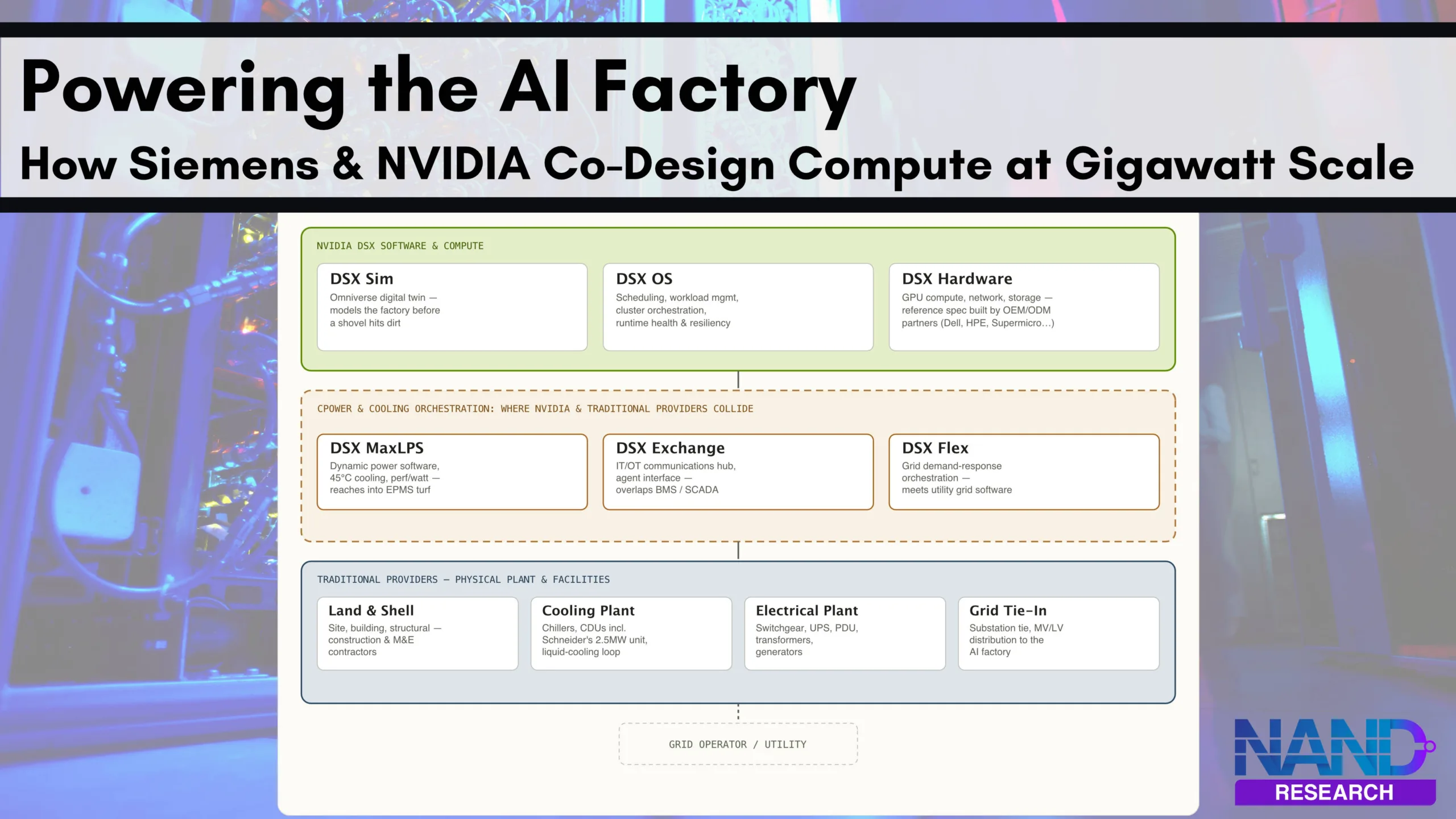
- NVIDIA contributes DSX MaxLPS, a software suite that dynamically allocates and optimizes power at the compute layer.
Together, the two companies have produced reference architectures that enable operators to simulate an entire AI factory before construction begins and increase both GPU density and performance per watt within a fixed power budget.
The AI Factory Challenge: Power as the New Bottleneck
Modern AI training and inference clusters now draw power at a scale that rivals that of small cities. Increasingly, the constraint on how quickly a new facility can come online is grid interconnects, transformers, and rack-level power delivery, a different story from just a few years ago when GPU availability was the constraint.
Traditional data center design compounds the problem. Facilities are typically provisioned for the worst case, reserving the maximum possible power draw for every rack regardless of actual workload. According to NVIDIA, for example, a 100 MW facility leaves roughly 40 kW of capacity stranded, reserved for a peak that rarely arrives.
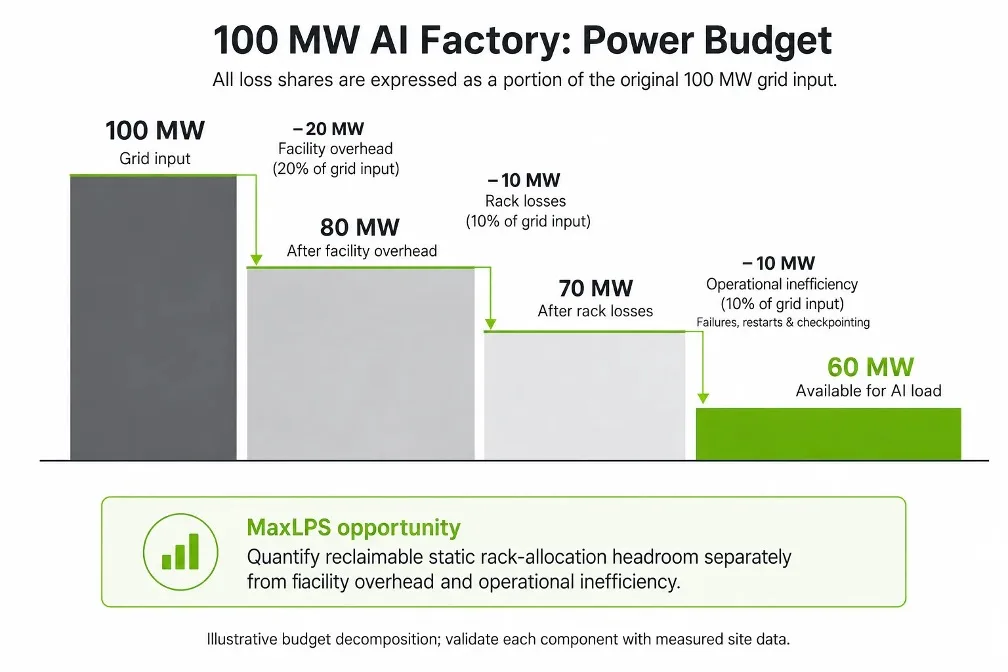
That waste multiplies at the gigawatt scale, where every stranded kilowatt represents GPUs that could have been powered.
Solving this requires precision at two layers:
- The physical layer, where power moves from the grid through switchgear, transformers, and busway to the rack, and where design decisions are effectively permanent once built
- The compute layer, where software decides, moment to moment, how delivered power is allocated across GPUs, racks, and workloads
No single vendor owns both layers end-to-end, which is why NVIDIA has drawn several infrastructure vendors into joint reference architecture work. Siemens is one of the deepest of those collaborations.
Siemens: Physical Infrastructure and Workload-Aware Simulation
Siemens’ contribution has two halves that reinforce each other:
- Electrical and automation infrastructure for everything else in the AI factory depends on
- A simulation layer that models how that infrastructure will behave under a given workload before it is built or run
The Physical Foundation
At the heart of every AI data center is its physical foundation, which Siemens addresses across several dimensions:
- An end-to-end electrical architecture spanning the full path from the utility connection at a nominal 34.5 kV, through medium-voltage distribution and modular low-voltage power blocks, to the rack interface
- Two named reference blueprints built for NVIDIA’s Vera Rubin DSX platform, the Siemens IEC AI Blueprint for Rubin DSX and the Siemens UL AI Blueprint for Rubin DSX, aligned with international and North American electrical standards, respectively
- Automation and energy management software that governs how the electrical infrastructure operates once live, paired with IoT-enabled facility hardware and cloud-based monitoring and control applications
- An integrated data center management suite giving operators a single view across power, cooling, and compute
Simulation, Digital Twins, and Workload-Aware Design
The physical blueprints are only half of what Siemens brings. The other half is Simcenter, Siemens’ multi-physics simulation platform, which models electrical, thermal, cooling, and control systems as a single coupled system.
This includes:
- System-level models that span direct-to-chip liquid-cooling loops, rack distribution units, chillers, and campus-wide HVAC, all in a single coupled simulation, executing in seconds to minutes of compute time
- Predefined, validated component libraries for refrigerant loops, chillers, heat pumps, and immersion systems, enabling engineers to compare air, liquid, and immersion cooling strategies against a specific workload profile before committing to one
- Power and microgrid modeling covering AC/DC distribution, power electronics, battery energy storage, and renewable or hydrogen integration, with dispatch strategies simulated alongside the electrical load they serve
- The executable digital twin compresses these physics-based models into lightweight, real-time representations using reduced-order modeling and AI, then deploys them to run continuously against live IoT data once the facility is operating
This is the layer that extends simulation beyond one-time design validation into ongoing workload optimization. Because Simcenter couples compute demand to power draw, heat generation, and cooling response within a single model, an operator can test how a specific training run or inference profile will move through the facility before scheduling, not just before the facility is built.
The executable digital twin extends that same modeling into live operations, supporting AI-driven load shifting and anomaly detection as workloads change in real time, a natural complement to NVIDIA’s performance-per-watt tuning.
NVIDIA DSX MaxLPS: Optimizing Compute Within the Power Envelope
Where Siemens engineers the envelope, NVIDIA DSX MaxLPS determines what happens inside it. Announced earlier this summer at GTC Taipei alongside the broader DSX platform, MaxLPS is a software suite designed to maximize token throughput per megawatt under a fixed power budget (trivia: the name stands for “Maximum Land Power Shell,” a reference to the hard site-level power ceiling every facility operates under).
MaxLPS works across three integrated layers:
- Dynamic power allocation, enabled by NVIDIA’s Dynamic Power Software, continuously monitors GPU, rack, and group-level consumption and reallocates unused headroom in real time within policy limits
- Performance-per-watt tuning, using workload profiles optimized separately for inference, training, and memory- or compute-bound jobs, and integrated with tools such as NVIDIA Dynamo
- Thermal efficiency is achieved by running liquid cooling at a 45°C inlet temperature, which reduces cooling overhead and allows facilities to rely more heavily on free cooling
A fourth component, DSX Exchange, extends this coordination outward, connecting compute-layer power decisions to building management systems and, ultimately, the grid.
DSX MaxLPS promises to return substantial results to data center operators:
- Up to 40% more Vera Rubin NVL72 GPUs deployable within an existing power budget
- Performance-per-watt gains of roughly 1.5x on GB200 NVL72 systems and 1.3 to 1.4x on Vera Rubin NVL72
- Rack-level power reductions from 125 kW to 90 kW on GB200, and from 136 kW to 101 kW on Vera Rubin, at the most energy-efficient operating point
These are compute-layer gains, achieved without touching a single transformer or switchgear cabinet. They depend entirely on the power reaching the rack being clean, predictable, and accurately modeled, which is exactly what infrastructure providers like Siemens provide.
Where the Two Stacks Meet
The dividing line between the two companies’ contributions is straightforward:
- Siemens defines and validates how much power reaches a rack and how reliably it arrives
- NVIDIA‘s MaxLPS decides in real time how the delivered power is allocated
The connective tissue is the digital twin. Siemens’ Simcenter and executable digital twin models integrate directly into NVIDIA’s Omniverse DSX blueprint, enabling co-design at gigawatt scale.
An operator can simulate the full path from utility feed to GPU workload before committing capital to a single rack, then keep simulating that same path under live conditions once the facility is running, with Siemens modeling how a workload moves through power and thermal systems, and MaxLPS deciding how to allocate power once it does.
A simplified way to picture the flow through the combined architecture:
- A Siemens-engineered utility interconnect and medium-voltage distribution system delivers power to the site
- Siemens automation software governs distribution down to the rack and reports into a single management view
- NVIDIA’s Dynamic Power Software allocates GPU-level power in real time within the MaxLPS-managed rack
- The Omniverse DSX digital twin mirrors every layer, from grid to silicon, for simulation and ongoing monitoring
The Partnership: Co-design at Gigawatt Scale
The DSX-specific reference architectures build on a Siemens-NVIDIA relationship that already spans industrial digitalization, manufacturing, and Omniverse-based simulation work. That existing familiarity between the two engineering organizations shaped how quickly the joint AI factory blueprints came together.
A few features distinguish this as genuine co-design:
- The reference architectures were developed and validated jointly
- Each company’s contribution maps to a distinct area of expertise, Siemens bridging digital and physical infrastructure from chip to grid, NVIDIA supplying the compute platform and AI software stack
- The shared Omniverse DSX digital twin gives both companies, and their mutual customers, one simulation environment
The broader DSX ecosystem adds further context for where Siemens sits:
- Engineering partners, including system builders like Dell, HPE, Lenovo, and Supermicro
- Neoclouds, including CoreWeave, Crusoe, and Lambda
- Engineering software partners, including Cadence, Dassault Systèmes, and PTC.
Within the electrical and power infrastructure category specifically, Siemens sits alongside several equally engaged competitors.
The Competitive Landscape: Siemens Among Several NVIDIA Infrastructure Partners
Siemens is not NVIDIA’s only infrastructure partner at this level of depth. NVIDIA has brought a set of power, electrical, and cooling vendors into the DSX ecosystem under a shared “grid-to-chip” framework, and several of them match or exceed Siemens on specific dimensions:
- Schneider Electric is the closest peer to Siemens in scope. It has co-developed AI factory reference designs with NVIDIA, including a liquid-cooling and power-management framework built on its Motivair acquisition and rated at 142 kW per rack for GB300 NVL72 systems. Its ETAP platform feeds grid-to-chip simulation into Omniverse DSX and is backed by $700 million in planned U.S. investment.
- Eaton has built a reference architecture around NVIDIA’s 800 VDC power design, contributing supercapacitors and busbar distribution, and supplies SimReady generator and switchgear assets to Omniverse DSX as part of its grid-to-chip strategy
- ABB has gone furthest on the digital twin side among the electrical vendors, embedding SimReady 3D models of its switchgear, distribution equipment, and UPS platforms directly into DSX co-design workflows, and separately collaborates with NVIDIA on 800 VDC architecture
- Vertiv is engaged more on cooling and prefabricated infrastructure than electrical distribution, building Vertiv OneCore Rubin DSX as a formal NVIDIA Partner Network member
- Trane Technologies rounds out the field on thermal management, optimizing cooling-plant efficiency within the DSX blueprint, the piece Siemens itself has flagged as not yet fully built out in its own reference designs
Taken together, Siemens’ advantage over this group of competitors lies in its breadth, with an end-to-end electrical stack paired with a mature simulation platform.
Schneider matches that breadth with a larger capital commitment, and Eaton and ABB are comparably embedded in electrical distribution, while Vertiv and Trane compete on narrower slices.
The practical differentiators are reference-design maturity for a given NVIDIA platform generation, the depth of digital twin integration, and fit with what a given site still needs to address.
Business and Operational Outcomes
For operators evaluating whether to build on these joint reference architectures, practical outcomes fall into a few categories:
- Lower cost per token, driven directly by MaxLPS’s energy optimization and Siemens’ reduction of electrical waste and stranded capacity
- Faster, lower-risk deployment, since full-stack simulation catches design flaws before construction rather than during commissioning
- Improved reliability, from coordinated monitoring across power, cooling, and compute
- Grid-responsive operation, relevant as utilities increasingly negotiate demand flexibility with large data center customers
- A credible path to gigawatt scale, since the joint architecture is designed to extend from a single facility to campus and multi-site deployments
Final Thoughts
AI factory scale is now constrained as much by power engineering as by silicon. The Siemens-NVIDIA collaboration demonstrates what it looks like to treat that as a single engineering problem rather than the traditional approach of handing separate problems to different vendors.
Siemens’ electrical and digital twin infrastructure defines a validated, simulation-ready power envelope, and NVIDIA’s DSX MaxLPS extracts the maximum useful compute from every watt within it.
For operators, investors, and utilities planning the next wave of AI infrastructure, the joint architecture is a practical blueprint for building gigawatt-scale AI factories without overspending on stranded power capacity or underdelivering on GPU throughput. It’s a powerful story.