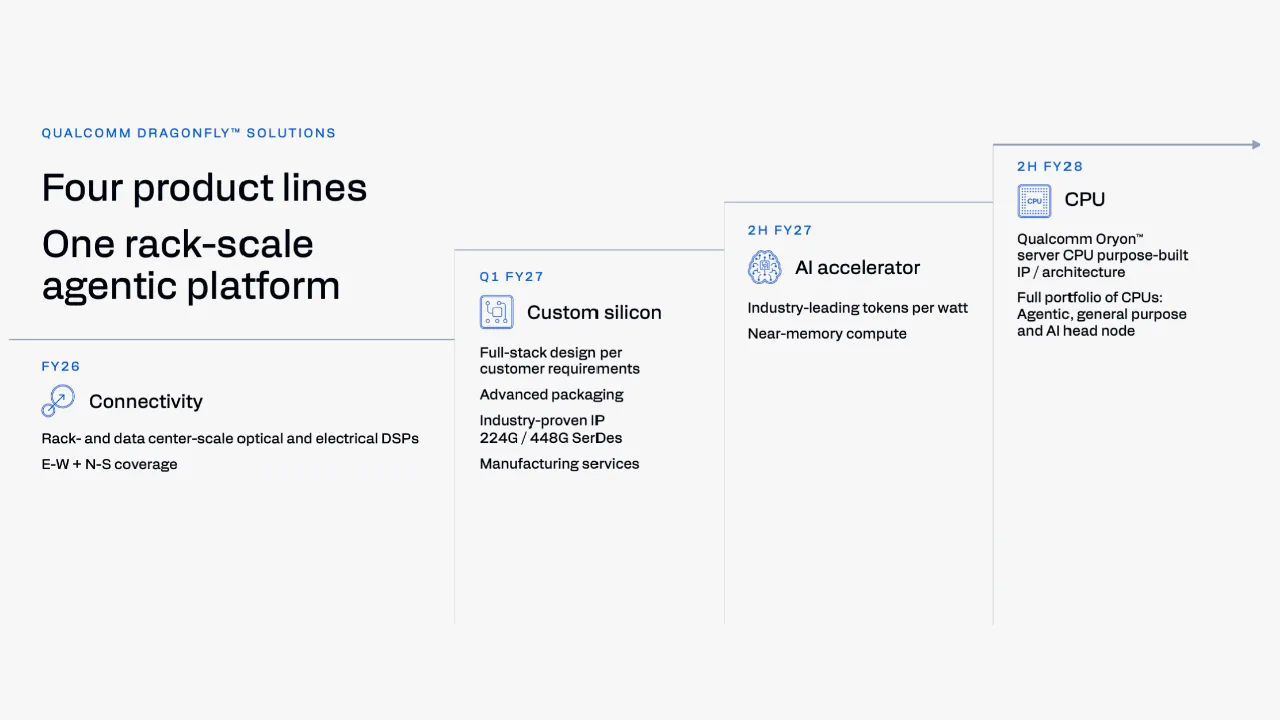
Qualcomm unveiled Dragonfly, its full-stack data center portfolio focused on AI inference, at its recent 2026 Investor Day. The portfolio brings together the Dragonfly C1000 data center CPU, the Dragonfly AI300 inference accelerator, the company’s new High Bandwidth Compute (HBC) near-memory architecture, a broad connectivity lineup, and a custom silicon practice.
The announcement goes beyond the AI200 and AI250 accelerators Qualcomm disclosed in October 2025, establishing an annual cadence for both CPUs and accelerators.
The announcement sees Qualcomm leveraging decades of mobile and PC silicon engineering into a credible third path for data center compute, competing against entrenched incumbents in both CPUs and AI accelerators. The claims are aggressive, the ecosystem support is broad, and the customer commitments are real.
Details
The Dragonfly portfolio spans silicon to rack and is built around a disaggregated, rack-scale architecture. It comprises four pillars: the C1000 CPU, the AI300 accelerator with HBC memory, a connectivity portfolio, and a custom silicon offering.
Qualcomm engineered the platform around performance-per-watt and token throughput, and it supports both air and liquid cooling for Open Compute Project ORv3-compliant racks and servers.
Dragonfly C1000 CPU
The C1000 is a purpose-built data center CPU for agentic, general-purpose, and AI head-node workloads. It features custom Qualcomm Oryon cores and a chiplet architecture:
- Custom Oryon CPU cores operating at frequencies above 5 GHz
- 250+ cores, using a multi-chiplet design with advanced packaging
- PCIe Gen 7 connectivity at more than 2 TB/s, plus CXL support for memory disaggregation
- RAS features including ECC, fault isolation, and error recovery
- Three CPU variants: an agentic CPU for orchestration, a general-purpose CPU, and an AI head-node CPU to maximize accelerator utilization
- Air and liquid cooling support on OCP ORv3 racks; optional HBC attach for CPU-based inference
Qualcomm claims more than 2x the performance per watt of competitive server CPU offerings, based on published specifications.
Commercial availability is expected in 2028.
High Bandwidth Compute (HBC)
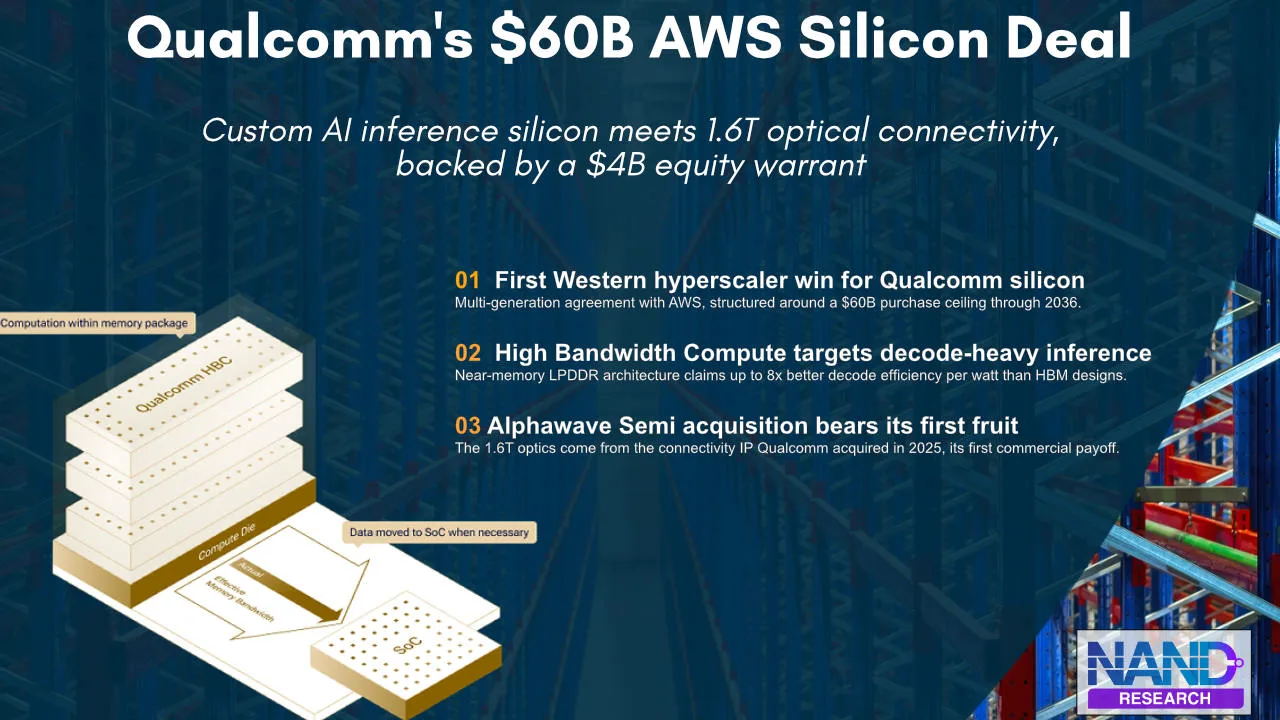
HBC is the most differentiated element of the portfolio. It is a near-memory computing architecture that bonds compute and memory in a 3D-stacked silicon package, and alternative to more traditional high-bandwidth memory (HBM).
Some specifics:
- HBC Gen 1 on the AI250 is designed for 133 TB/s per card, an 18x increase in effective memory bandwidth over the AI200 with LPDDR5X
- HBC Gen 2 on the AI300 is designed for a 54x increase in effective bandwidth over the AI200
- A claimed 6x increase in bandwidth per watt versus HBM, normalized at card level against published specifications
- A claimed 200x increase in capacity per watt versus SRAM, normalized at rack level
Commercial sampling of HBC Gen 1 with the AI250 is expected in mid-2027.
Dragonfly AI300 Accelerator
The AI300 is Qualcomm’s third-generation rack-level inference platform, following the AI200 and AI250. It integrates HBC Gen 2 and targets LLMs, multimodal, and agentic inference.
Key details include:
- Air- and direct-liquid-cooled rack-level design for disaggregated inference
- Scale-up over UALink and ESUN (Ethernet for Scale-Up Networking); scale-out over copper and optical
- A claimed 4x to 8x better performance per watt than existing GPU architectures on memory bandwidth per watt per card
- Commercial sampling expected in 2028
Connectivity and Custom Silicon
The connectivity portfolio spans die-to-die, copper, optical, and campus-reach interconnects. It supports 800G and 1.6T links across optical transceivers, active optical cables, and active electrical cables, reaching campus deployments up to 20 km.
The portfolio combines Qualcomm’s SerDes, PAM4 signaling, coherent-lite DSP, and telemetry.
Qualcomm’s custom silicon practice offers end-to-end co-design across silicon, system, and software, advanced packaging, and manufacturing execution, drawing on Qualcomm’s existing IP base.
Portfolio and Availability Summary
The following summarizes the core components, their memory or compute approach, key claims, and expected availability:
| Component | Approach | Key Claim | Availability |
| C1000 CPU | Oryon cores, 250+ core chiplet, PCIe Gen 7 | 2x+ perf/watt vs competitive server CPUs | 2028 |
| HBC Gen 1 (AI250) | 3D-stacked near-memory | 133 TB/s per card, 18x vs AI200 | Sampling mid-2027 |
| HBC Gen 2 (AI300) | 3D-stacked near-memory | 54x bandwidth vs AI200 | 2028 |
| AI300 accelerator | Rack-level inference, HBC Gen 2 | 4x-8x perf/watt vs GPUs | Sampling 2028 |
| Connectivity | Optical, AEC, AOC, die-to-die | 800G/1.6T, up to 20 km reach | Not disclosed |
Analysis
Dragonfly accelerates Qualcomm’s diversification strategy, allowing the company to expand into a full-stack data center supplier.
The portfolio is deliberately narrow at the workload level, focused on inference rather than training, and deliberately broad at the stack level, spanning CPU, accelerator, memory, and interconnect.
Qualcomm is making the smart bet that agentic AI will shift the dominant data center workload toward inference, where its low-power design heritage is a critical advantage:
- The multi-generation Meta agreement, announced alongside the portfolio, give Qualcomm concrete validation and a reference deployment at the largest scale
- Support from more than 35 ecosystem partners, including Micron, SK hynix, Samsung SDS, Supermicro, Lenovo, and VAST Data, lends strong credibility to the rack-scale story.
- The HBC bet differentiates Qualcomm from accelerator vendors that rely on the constrained and expensive HBM supply chain
Competitive Landscape
Qualcomm enters two contested markets at once:
- In data center CPUs it faces AMD and Intel in x86, plus Arm-based incumbents including AWS Graviton, NVIDIA Grace, and Arm’s own announced processor.
- In AI accelerators, it faces NVIDIA’s dominant inference and training franchise, AMD’s Instinct line, and the in-house silicon programs at every major hyperscaler.
At a high-level, the compeititve situation looks like this:
- Against NVIDIA, Qualcomm’s genuine differentiation is the HBC memory architecture and a tokens-per-watt argument, but NVIDIA holds an enormous software and ecosystem advantage in CUDA and a shipping product cadence Qualcomm has yet to demonstrate
- Against AMD and Intel CPUs, the Oryon-based C1000 offers a competitive core count and a performance-per-watt claim, but both incumbents will have shipped multiple generations before the C1000 reaches availability in 2028
- Against hyperscaler in-house silicon, Qualcomm offers a merchant alternative that spreads engineering cost, but it must win against teams optimizing for their own workloads. Here the company competes most directly against Broadcom and Marvell.
The clearest competitive risk is the timeline. Competitors will not stand still through 2027 and 2028, and the performance and efficiency claims Qualcomm makes today are measured against current products, not against what incumbents will ship by the time Dragonfly arrives.
Final Thoughts
Overall, Qualcomm has assembled a coherent and ambitious data center strategy. Dragonfly is a full-stack platform built around the thesis that agentic inference will dominate data center workloads, and tokens-per-watt will determine the economics.
Its HBC near-memory architecture is the most technically interesting element, and the Meta agreement gives the strategy a credible anchor customer at hyperscale. The breadth of ecosystem support across memory, server, and storage vendors reinforces the seriousness of this entry.
Qualcomm still has significant milestones to reach before Dragonfly can compete with established platforms in production deployments. It must execute an aggressive product roadmap, validate HBC at scale, and build a software ecosystem that meets customer expectations. These are substantial challenges in a market where competitors iterate annually and customers demand proven reliability.
Even so, Dragonfly marks one of the most consequential strategic expansions in Qualcomm’s history. Rather than extending its mobile heritage into adjacent markets, the company has designed an architecture specifically for the next phase of AI infrastructure.
As inference becomes the dominant workload, and as token efficiency becomes the industry’s primary economic constraint, Dragonfly could arrive at precisely the right moment.
Regardless of its ultimate market share, Qualcomm has already accomplished something important: it has given customers and hyperscalers a credible new architectural option in a market that has long needed more competition.
For additional coverage, see the author’s Forbes article on Qualcomm’s 2026 Investor Day, which includes additional discussion of the Dragonfly portfolio.