Veeam connects data context, AI agent activity, and backup state in a single recovery workflow
Veeam announced that its Intelligent ResOps (iResOps) for Microsoft 365 is now generally available. The product is an add-on to Veeam Data Cloud for Microsoft 365 that discovers Microsoft Copilot and other AI agents within a tenant, maps the sensitive data each agent can access, identifies redundant, obsolete, and trivial (ROT) content, and allows administrators to reverse agent-driven file changes, one file at a time.
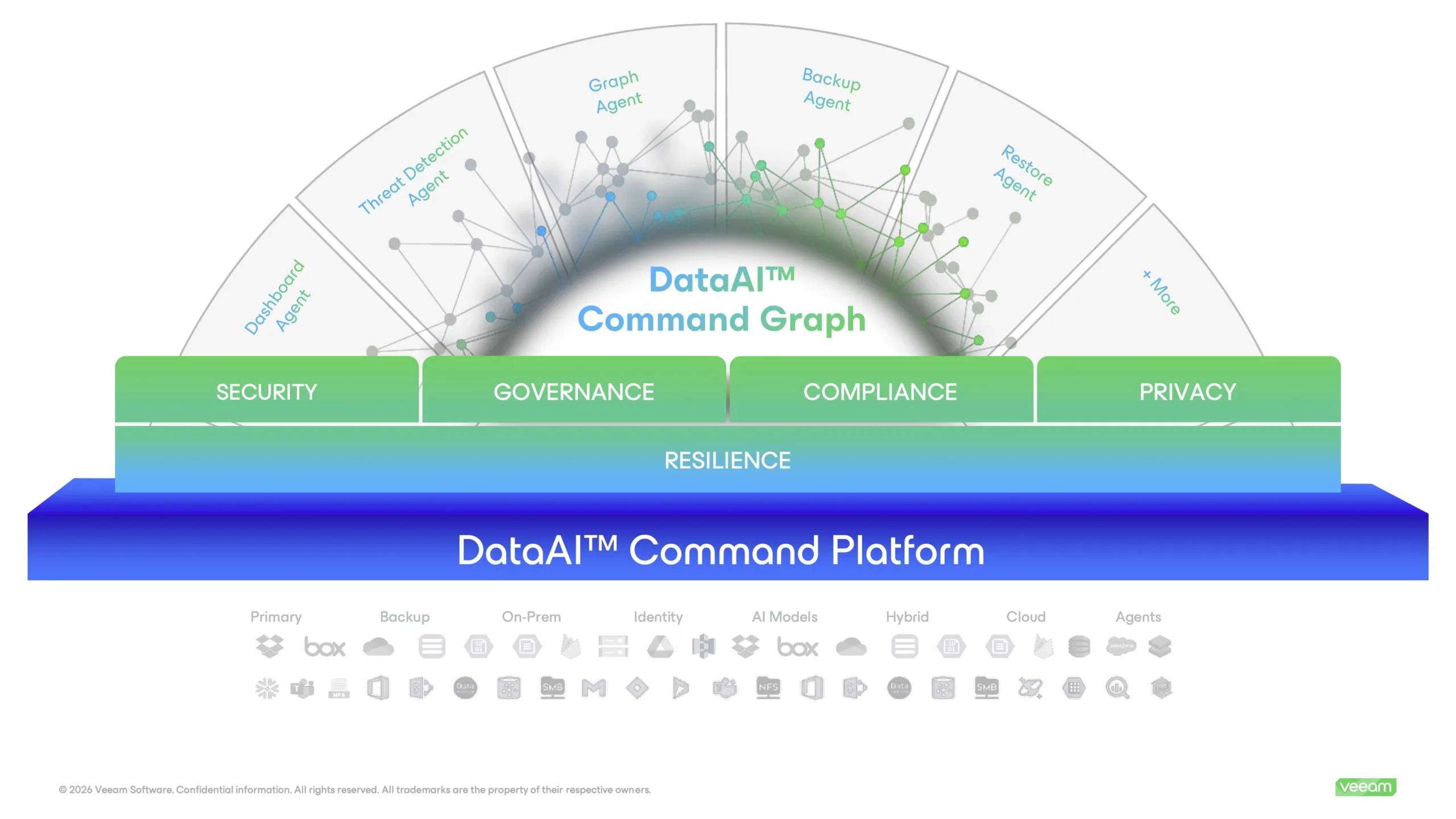
iResOps is the first generally available product built on the DataAI Command Platform, introduced earlier this year at Veeam’s VeeamON New York event, following Veeam’s roughly $1.7 billion acquisition of Securiti AI.
The release marks the first concrete delivery from Veeam’s acquisition of Securiti. Veeam also opened private previews of iResOps for Veeam Data Platform and Okta, and plans to open previews for GitHub, Azure DevOps, and Google IAM in Q4 2026.
The Microsoft 365 release gives customers and competitors the first opportunity to evaluate whether Veeam can turn a data security acquisition into an operational resilience product.
Technical Details
Intelligent ResOps for Microsoft 365 layers a data intelligence service on top of an existing Veeam Data Cloud for Microsoft 365 subscription. Customers connect their Veeam Data Cloud tenant to the DataAI Command Platform and configure a Microsoft 365 connector. Veeam says the process takes a few clicks and requires no data migration or changes to the existing backup architecture.
Architecture
The core of the product is the DataAI Command Graph, a continuously updated model that maps production Microsoft 365 data to its backup state. The graph correlates several classes of information that customers typically collect from separate tools:
- Asset inventory: Files, mailboxes, sites, and channels across Exchange Online, OneDrive, SharePoint Online, and Teams.
- Identity mapping: Human users and non-human identities, including Copilot and other AI agents, along with the permissions each holds.
- Activity telemetry: Records of who or what accessed or modified content, which supports per-file change tracking.
- Protection state: Backup coverage and restore-point context for the same assets, drawn from Veeam Data Cloud.
Much of the classification and posture technology originates with Securiti AI, whose data command graph predates the acquisition. Veeam has rebranded and extended it into the DataAI Command Graph and now applies it to backup data alongside production data.
Capabilities
Veeam groups Microsoft 365 functionality into five operational outcomes, each mapping to a specific set of tasks for IT, security, and compliance teams:
- AI agent visibility and rollback: Discovers Copilot and other agents in the tenant, including those IT did not know about, and shows which sensitive data each can access. When an agent incorrectly modifies or deletes files, administrators can review changes file by file and selectively undo them. Veeam calls this capability Agent Commander.
- Sensitive data classification: Continuously discovers and classifies sensitive and regulated data across the four core Microsoft 365 workloads and reports which users and agents have access to that data.
- ROT identification: Flags redundant, obsolete, and trivial content and quarantines it while teams decide whether to archive or delete it, reducing both exposure and backup storage consumption.
- Coverage validation: Confirms that business-critical data is protected and surfaces coverage gaps before an incident, enabling recovery teams to identify where priority data resides.
- Natural-language investigation: Built-in agents let authorized staff query data, access, agent activity, and protection status using plain language.
Packaging and Availability
iResOps for Microsoft 365 ships in Foundation and Advanced editions and is also sold through Veeam Cloud and Service Providers. It is not available as a standalone product. The private previews extend the same model to other estates:
- Veeam Data Platform: Connects existing on-premises backup servers to a cloud console with global search across protected and production data, three built-in agents (Dashboard, Graph, and Backup Admin), and centralized RBAC, SSO, and MFA. It accompanies Veeam Data Platform v13.2, which Veeam will ship later in Q4 2026.
- Okta: A managed service that creates immutable restore points across 29 Okta object types and restores objects, including their memberships, app assignments, federation settings, and roles, in dependency order.
Analysis
iResOps is the first product that makes Veeam’s rebranding as the “Data and AI Trust Company” tangible. Before the Securiti acquisition, Veeam competed primarily on backup breadth, recovery reliability, and installed base.
The DataAI Command Platform extends the company’s reach into data security posture management, governance, and AI oversight, and iResOps ties those capabilities back to the recovery function, where Veeam already holds a strong share.
Microsoft 365 is a logical first workload because Veeam currently protects more than 26 million users on the platform, and it is where Copilot agents interact with the largest volume of unstructured enterprise data.
Practitioner Impact
The primary audience comprises the Microsoft 365 administrator or resilience team already running Veeam Data Cloud, along with security and compliance staff who share responsibility for Copilot rollouts.
For these teams, iResOps consolidates agent discovery, data classification, and backup coverage into a single console directly tied to recovery actions.
The most practical benefit is selective rollback. When an agent with broad write access damages content across a large site, selectively rolling back only the affected files preserves legitimate edits made by other users since the last restore point.
Competitive Impact
Every major data protection vendor is racing to integrate security posture and AI agent controls into Microsoft 365 backup. The competitive set includes direct backup rivals that have built or partnered to offer similar capabilities, Microsoft’s native tooling, and data security specialists that approach the problem from the access-governance side.
Veeam’s release is well-timed, reaching general availability ahead of Commvault‘s comparable Microsoft 365 add-ons, which enter early access in the coming weeks.
The table below summarizes the principal alternatives:
| Alternative | Model and Approach | Agent and AI Controls | Compared to Veeam iResOps for M365 |
| Veeam iResOps for Microsoft 365 | Add-on to Veeam Data Cloud for Microsoft 365 built on Securiti technology | Agent discovery, sensitive-data reach, file-level rollback of agent changes | Generally available now with classification, ROT, coverage, and agent rollback in one graph |
| Commvault Threat Scan and Data Posture 360 | Paid add-ons to Commvault Backup and Recovery for Microsoft 365 | No agent-specific controls disclosed | Stronger malware scanning of historical backups. Early access pending with GA planned for early 2027 |
| Rubrik Agent Cloud and Intelligent Business Recovery | Separate agent operations platform plus Microsoft 365 recovery service | Agent discovery, monitoring, policy, and undo across Copilot Studio, Bedrock, and Agentforce | Broader multi-platform agent coverage. Agent controls sit in a separate product from Microsoft 365 backup context |
| Cohesity DSPM and Gaia | DSPM through Cyera partnership, plus Gaia AI search over backup data | Agent resilience through Datadog and ServiceNow partnerships | Comparable posture capabilities, delivered through partner OEM integrations |
| Microsoft Purview and Microsoft 365 Backup | Native classification, DSPM for AI, lifecycle management, and backup | Copilot data governance and oversharing controls | Included in many enterprise licenses. Weaker on granular rollback and independent backup copies |
| Varonis and other DSPM vendors | Standalone data security and access governance | Copilot exposure analysis and permission remediation | Deeper access-governance heritage with no direct link to restore points |
Veeam’s differentiation is strongest where recovery and context meet. No competitor currently offers a generally available, file-level reversal of agent changes within the same product that holds Microsoft 365 backup data and sensitive-data classification.
Differentiation is weakest in pure classification and access governance, where Microsoft Purview arrives bundled with existing licenses, while specialists such as Varonis offer deeper remediation workflows.
Rubrik poses the most direct conceptual challenge. Its Agent Cloud spans agents across multiple platforms beyond Microsoft 365, and customers with heterogeneous agent estates will weigh that breadth against Veeam’s deeper Microsoft 365 integration.
Final Thoughts
Veeam has met the first milestone of its Securiti integration roughly five months after announcing the DataAI Command Platform. iResOps for Microsoft 365 is a credible, generally available product that addresses an operational problem most backup tools overlook: understanding what changed, who or what changed it, and how to restore only the damaged content.
Private previews of Veeam Data Platform and Okta indicate that the graph model extends beyond SaaS collaboration data to on-premises infrastructure and identity.
For organizations rolling out Copilot and custom agents at scale, the key question is how quickly they can recover from an agent that does the wrong thing, even with legitimate permissions.
Veeam now offers a generally available answer to that question within the backup service many enterprises already trust with their Microsoft 365 data, giving it a meaningful lead as data resilience and AI governance converge into a single buying decision.