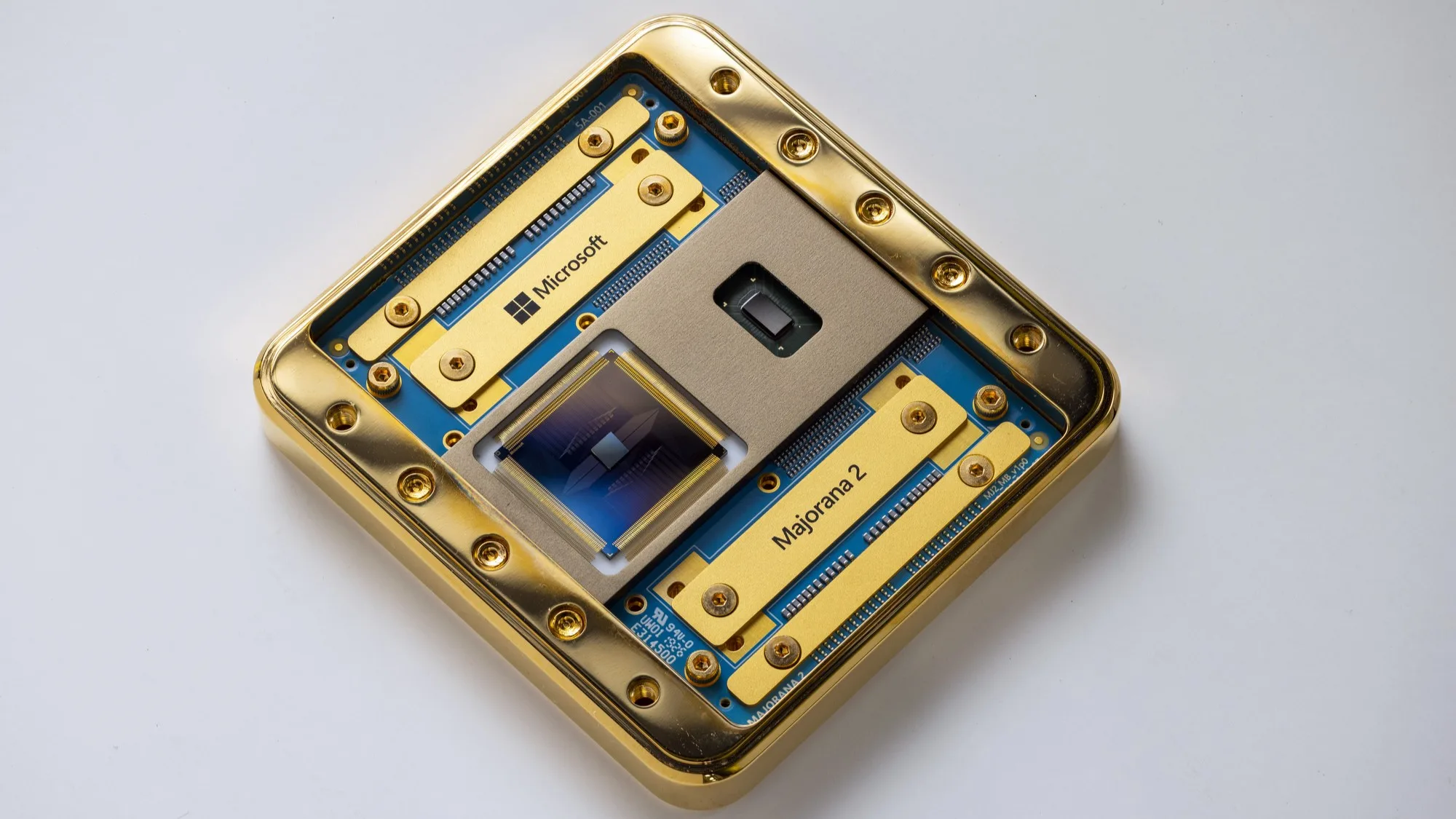
Microsoft unveiled Majorana 2 at its recent Build developer conference in San Francisco. Majorana 2 is its second-generation topological quantum chip. Microsoft also announced the general availability of Microsoft Discovery, its agentic AI platform for scientific research and development.
Majorana 2 delivers qubits that are 1,000 times more reliable than those in its predecessor, Majorana 1, with a mean qubit lifetime of 20 seconds and peak instances approaching 1 minute.
Crucially, Microsoft says these gains allow it to cut its quantum roadmap timeline in half, with a target of a scalable commercial quantum computer by 2029.
Announcement Details
Majorana 2 extends Microsoft’s long-running bet on topological quantum computing, an approach that stores quantum information in the physical shape of a material rather than in the state of a single particle. Topological qubits theoretically offer inherent protection against environmental noise, which is the primary source of errors in competing approaches.
Majorana 2 builds on the topological qubit architecture Microsoft introduced with Majorana, but delivers substantial materials changes rather than incremental fabrication improvements.
The chip’s qubits are built from structures called tetrons, which are pairs of superconducting nanowires designed to host Majorana zero modes at their endpoints. Information is stored in the parity of electrons occupying the topoconductor wire, and quantum operations are performed by measuring that parity rather than by directly controlling the quantum state.
This measurement-based approach produces digital outputs and, in theory, reduces sensitivity to the analog errors that affect superconducting gate-based qubits.
The key technical changes in Majorana 2 include:
- Materials stack replacement: Majorana 2 replaces the aluminum superconductor used in Majorana 1 with lead. Lead provides a superconducting gap of approximately 1,300 microelectronvolts, compared with approximately 300 microelectronvolts for aluminum. The larger gap makes it harder for environmental disturbances to generate quasiparticle excitations that destabilize the topological phase.
- Semiconductor redesign: The active semiconductor region transitions from pure indium arsenide to a composite of indium arsenide and indium arsenide antimonide, grown on a gallium antimonide substrate. Microsoft says that this combination produces a more stable topological phase boundary.
- Topological gap expansion: Majorana 2’s topological gap, the energy range where parity is protected, is more than twice as large as Majorana 1’s. A larger topological gap directly reduces the probability of error-causing excitations.
- Qubit lifetime: Majorana 2 has a mean qubit parity lifetime of 20 seconds, with peak instances exceeding one minute. Majorana 1 operated in the 1-to-12-millisecond range. Competing superconducting and trapped-ion qubits typically exhibit coherence in the microsecond to low-millisecond range.
- Agentic AI integration: Microsoft used its Discovery platform throughout the development of Majorana 2. AI agents automated qubit measurement workflows that previously took weeks per cycle, analyzed approximately two decades of experimental data spanning formats and research silos, optimized materials fabrication through simulation, and detected an uncalibrated temperature sensor that was introducing noise into the fabrication process.
- Manufacturing site: Primary development occurs at Microsoft’s Quantum Lab in Lyngby, Denmark.
- Peer review: Microsoft published the paper “20 Second Parity Lifetime in an InAs-Pb Tetron Device” alongside the Majorana 2 announcement. The paper documents the materials results and lifetime measurements.
Alongside Majorana 2, Microsoft made Microsoft Discovery generally available. Discovery deploys autonomous AI agent teams, guided by human researchers, to manage research workflows, generate hypotheses, optimize experiments, and validate results.
The platform includes a Discovery Engine for research and reasoning, enterprise-grade security and governance controls, and Azure integration. Microsoft also released a free local Discovery application for individuals with a GitHub Copilot account.
Analysis
Microsoft’s Majorana 2 is based on the thesis that, if realized, topological qubits will achieve a scale-to-reliability ratio that superconducting and trapped-ion approaches cannot match. Microsoft claims a path to one million qubits on a single chip, a figure that, if achievable, would confer a structural advantage in a fault-tolerant quantum future.
Microsoft’s overall Azure Quantum strategy isn’t reliant on its Majorana 2 efforts; instead, it hedges with other vendors. By aggregating IonQ, Quantinuum, Rigetti, and Atom Computing under Azure Quantum, Microsoft captures commercial quantum revenue regardless of when its own Majorana hardware reaches production.
This approach keeps Azure Quantum as a quantum cloud platform independent of Microsoft’s hardware timeline.
Importantly, Microsoft’s 2029 target aligns with Google and IBM’s stated goals for a commercially viable fault-tolerant quantum computer, creating direct competition between topological and superconducting error-correction approaches within the same timeframe.
Impact on Practitioners
The primary audience for Majorana 2 includes quantum researchers, national laboratories, and government programs evaluating long-range quantum computing roadmaps. No commercial quantum computing product or service based on Microsoft’s own hardware is available today; the company expects to reach utility-scale capability by 2029.
Organizations making near-term quantum computing decisions continue to access quantum resources via Azure Quantum, which aggregates hardware from IonQ, Quantinuum, Rigetti, and other vendors.
Overall, we view the impact as follows:
- For quantum researchers: the materials science results in the Majorana 2 paper are substantive, regardless of the contested topological interpretation. The lead-based superconducting stack and the composite semiconductor region constitute genuine advances in hybrid semiconductor-superconductor device engineering.
- For enterprise technology planners: Majorana 2 reinforces that Microsoft’s proprietary quantum hardware has a long-term role. Organizations building quantum strategies today should treat Microsoft’s topological roadmap as a watch item rather than an implementation priority.
- For organizations evaluating Microsoft Discovery as a standalone platform: the quantum team’s use case provides a concrete demonstration of agentic AI in hardware R&D, including measurement automation, multi-decade data synthesis, and manufacturing optimization. These use cases apply to life sciences, materials science, and chemical engineering workflows, where early Discovery customers are already active.
Competitive Landscape
The quantum computing market in 2026 bifurcates into vendors delivering near-term commercial value on existing hardware and vendors investing in long-horizon architectures that may eventually supersede current approaches.
Microsoft holds the long-horizon position with the most contested underlying physics. Its competitors range from IBM and Google, which pursue superconducting qubits and have achieved verified error-correction milestones, to Quantinuum and IonQ, which operate trapped-ion systems with commercial traction.
| Competitor | Competitive Position | Differentiation |
| IBM (Heron R2) | • 156-qubit superconducting processor in commercial production • Deepest enterprise sales motion in quantum • Roadmap targets quantum advantage demonstration in 2026 | • Mature hardware shipping at scale • Proven error correction benchmarks • Extensive developer ecosystem with Qiskit |
| Google (Willow) | • 105-qubit Willow chip demonstrated below-threshold quantum error correction in late 2024 • Claims 13,000x speedup over fastest classical supercomputers on benchmark tasks | • Demonstrated fault-tolerance milestone with verified error correction below threshold • Strong materials science and fabrication capability |
| Quantinuum (H-Series) | • Trapped-ion systems with the highest gate fidelity of any commercially available quantum hardware • Recent IPO | • Highest-quality logical qubits among commercially available systems • TKET software stack provides broad circuit compatibility • Near-term enterprise applicability in chemistry and optimization |
| IonQ | • Largest pure-play quantum company by revenue • Broad acquisition strategy | • Proven commercial traction with enterprise customers • All-to-all qubit connectivity • Expanding through acquisitions across multiple qubit modalities |
Microsoft’s biggest competitive advantage over its pure-play competitors is its balance sheet strength (an advantage shared by IBM). Building a topological quantum computer requires sustained investment across materials science, cryogenics, fabrication, and software over a timeline measured in years, not quarters.
Microsoft can absorb that cost structure while generating revenue from Azure Quantum and Discovery. IonQ, Rigetti, and D-Wave face ongoing pressure to dilute equity to fund R&D, which limits their ability to pursue long-horizon architecture bets.
Skepticism
Despite the headline performance figures, Majorana 2 faces skepticism from independent physicists and quantum researchers who question whether Microsoft has verified the presence of true Majorana zero modes, the exotic quantum states that underpin its approach.
In 2021, the company retracted a high-profile Nature paper on its topological claims, and critics argue that the underlying measurement challenges remain unresolved.
Microsoft’s selection by DARPA for the final phase of its Underexplored Systems for Utility-Scale Quantum Computing (US2QC) program offers some third-party validation, but independent replication of the core physics claim is still absent from the public record.
Final Thoughts
Majorana 2 advances Microsoft’s topological quantum program in a substantive way:
- Replacing aluminum with lead as the superconducting layer yields measurably better device properties.
- Qubit parity lifetimes, if reproducible, is a significant advancement over prior generations.
- Microsoft’s decision to publish a peer-reviewed paper alongside the announcement (rather than relying solely on press releases) is a more rigorous evidentiary posture than earlier announcements.
- DARPA’s selection of Microsoft for the final phase of the US2QC program lends credibility.
The fundamental unresolved question is whether Microsoft has demonstrated true topological protection of quantum information, rather than merely longer-lived device measurements that could have alternative physical explanations.
Independent physicists who have followed the program closely remain unconvinced, and the pattern of bold claims preceding independent validation persists with Majorana 2. Until external researchers reproduce the parity lifetime results and confirm their topological origin, the 1,000x reliability claim carries a measurement-interpretation risk that shouldn’t be discounted.
The 2029 target for a scalable commercial quantum computer is achievable if the topological protection mechanism performs at scale, manufacturing yields improve sufficiently to enable multi-qubit integration, error-correction overhead remains within the levels the topological architecture promises, and competing approaches do not achieve a fault-tolerant advantage first. Each of these conditions is meaningful.
The company’s broader commercial strategy for quantum computing isn’t reliant on its advancements with Majorna, but, if that program continues to be successful it will give Microsoft an opportunity to differentiate. Overall, Microsoft’s quantum computing story is compelling and worth watching.