At its INSIGHT 2026 conference in Las Vegas, NetApp announced NetApp Novus, its new storage architecture for neocloud operators, hyperscalers, GPU-as-a-Service providers, and large enterprises building their own GPU clouds.
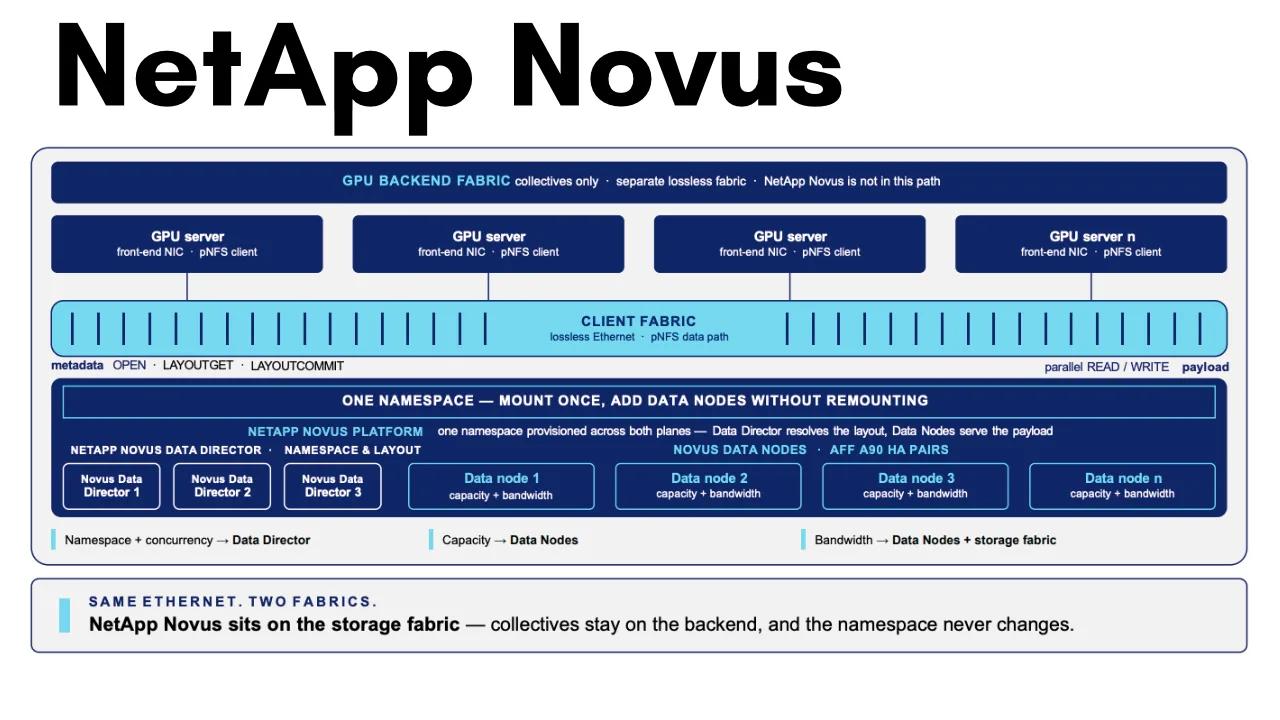
Novus separates file system metadata from the data path, running metadata on a new software layer called Novus Data Director while ONTAP-based AFF A90 systems serve data. GPU servers see the combined system as a single namespace accessible via standard parallel NFS.
NetApp states that the architecture scales beyond 100 TB/s of aggregate throughput, and the initial configuration is now orderable.
Just four days prior, NetApp announced its intent to acquire PEAK:AIO, a UK-based developer of disaggregated pNFS metadata technology. The two moves target the same architectural constraint.
Metadata operations, more than raw bandwidth, limit how far a shared file system can scale under the concurrency of large GPU clusters. ONTAP’s controller-centric heritage required a new answer before NetApp could compete for the largest AI deployments.
Novus is NetApp’s entry into the AI factory storage tier, already contested by VAST Data, WEKA, DDN, Everpure, and Dell Technologies. It opens the neocloud and hyperscale GPU infrastructure to NetApp, strengthens its standing with HPC buyers, and provides an architectural foundation for enterprise data centers as agentic AI brings large-scale inference on-premises.
Background: How Storage Architecture is Evolving for Agentic AI
Enterprise storage grew around controller pairs serving a bounded set of applications. AI training broke that model first, as GPU clusters demanded aggregate bandwidth measured in terabytes per second and triggered checkpoint writes that hit every storage node at once.
Agentic AI shifts the pressure in a new direction. Agents issue large volumes of small, concurrent reads against retrieval indexes, vector stores, and document repositories, while long-context, multi-turn inference generates a KV cache that now spills from GPU memory into shared storage.
These workloads stress metadata and concurrency more than capacity. NetApp describes the core problem directly. Every open, lookup, and layout request lands on the same controllers that serve data, and small-file metadata traffic and large sequential checkpoint writes degrade each other when they share hardware.
NetApp also claims that GPU utilization in poorly fed AI factories falls below 30%, making storage performance a direct input to cost per token.
The storage industry’s response has been consistent enough to establish a new architectural baseline. Its common elements now appear across nearly every vendor selling into large AI environments:
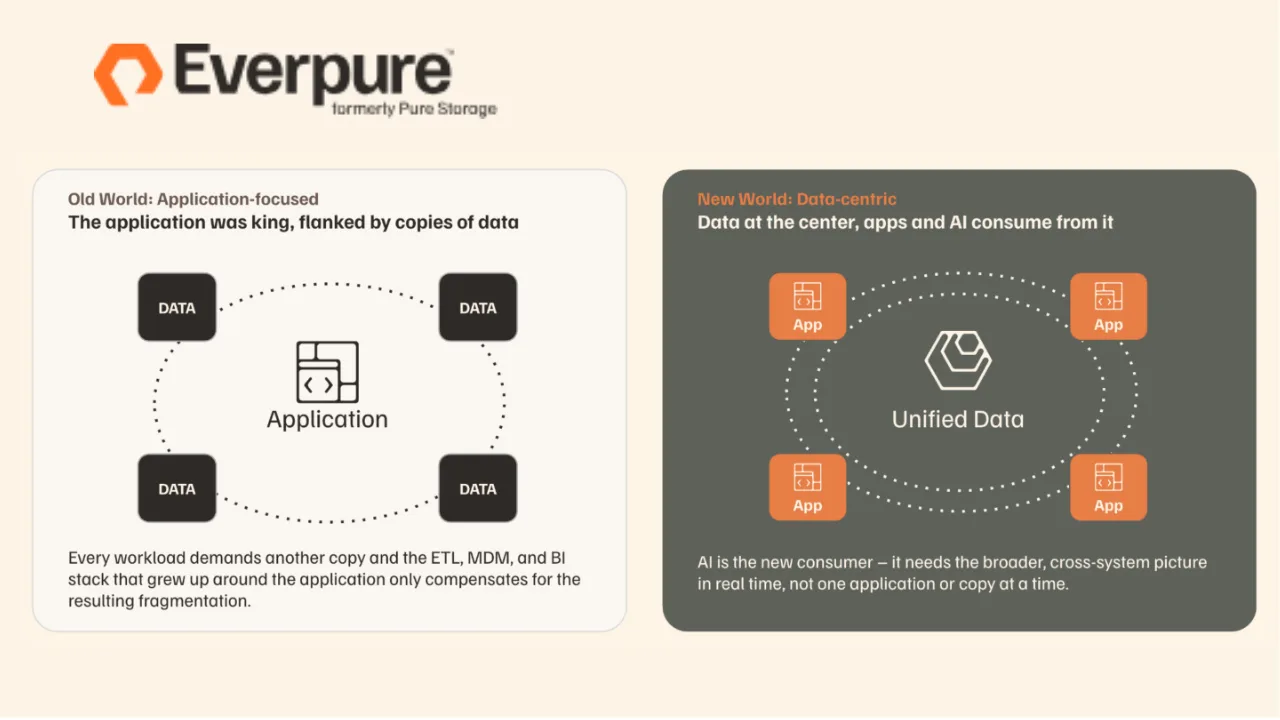
- Disaggregated metadata: Metadata services scale independently of capacity and bandwidth, an approach evident in Everpure FlashBlade//EXA, VAST Data’s DASE architecture, and now in Novus.
- Standards-based parallel access: pNFS with the in-box Linux client is displacing proprietary parallel file system clients, and Hammerspace, Everpure, and NetApp are all building on it.
- A context memory tier: NVIDIA’s BlueField-4-based CMX context memory platform and the STX reference architecture formalize shared storage as an extension of GPU memory for agentic inference, with participation from NetApp, Dell, HPE, VAST Data, WEKA, DDN, and others.
- Multi-tenancy and governance at scale: Shared GPU infrastructure now hosts many customers and autonomous agents simultaneously, making tenant isolation, quality of service, and access control core storage requirements.
No single vendor is driving this shift. The economics of GPU utilization and the access patterns of agentic workloads are compelling every storage supplier, whether AI-native or established, to rebuild its architecture.
Novus is NetApp’s version of that rebuild, and the PEAK:AIO acquisition is the engineering investment underpinning it.
Details
Novus combines two independently scalable planes into a single file system namespace. The first release pairs Novus Data Director metadata software on qualified Supermicro x86 servers with ONTAP data services on AFF A90 systems, NetApp’s bandwidth-optimized storage platform.
Its operation is straightforward: A GPU client asks Data Director where a file resides, receives a layout, and then reads and writes directly to the ONTAP data nodes. The key differentiator is that metadata and data traffic never compete for the same controller.
The architecture comprises the following elements:
- Metadata plane: Novus Data Director operates as a software-defined control layer on standard x86 compute and scales independently of the data tier.
- Data plane: ONTAP on AFF A90 serves data and supports ONTAP snapshots, replication, quality of service, security, and multi-tenancy in the AI factory tier.
- Client access: GPU servers connect via standards-based pNFS and NFS using supported Linux client environments. Futurum reports that the implementation uses the Flex Files layout in NFS 4.2. No proprietary client software is required.
- Single namespace: NetApp describes a zettabyte-scale namespace that holds billions of files, allowing operators to add capacity and performance without application changes, remounts, or tenant interruptions.
- Scale claims: NetApp claims more than 100 TB/s of aggregate throughput, which, by its own arithmetic, sustains roughly 2 GB/s per GPU across 50,000 GPUs. In an unusual move for a product launch, NetApp had the analyst firm Omdia audit its testing. Omdia observed near-linear scaling as ONTAP clusters were added to a single namespace and projected that the design will reach 100 TB/s of sequential read throughput with dozens of exabytes of effective capacity.
- Infrastructure partner. Supermicro supplies the qualified metadata servers as part of a broader NetApp and Supermicro collaboration announced the same day, which also includes the NetApp AIPod, built by Supermicro to NVIDIA’s enterprise reference architecture.
The initial configuration is orderable today, with early customers expected to receive systems within one to two months. Software-defined versions will follow.
Analysis
Novus extends NetApp’s architecture from enterprise storage into the AI factory tier without forking ONTAP. That consistency is the strategic core of the launch. NetApp can now offer a single data management model spanning branch systems, the disaggregated AFX platform, first-party services on AWS, Azure, and Google Cloud, and GPU clusters at neocloud scale.
Novus advances NetApp’s position across four fronts.
Neocloud and hyperscaler opportunity
NetApp has played a limited role in the largest GPU buildouts, where VAST Data, WEKA, and DDN have won most neocloud storage deals. Novus gives NetApp a credible product for that segment, and its multi-tenancy, quality of service, and security capabilities align with the operating model of GPU-as-a-Service providers that host many customers on shared infrastructure.
NetApp also brings assets that AI-native specialists lack, including first-party ONTAP services across all three major hyperscale clouds and a large enterprise installed base whose AI workloads increasingly land in neocloud tenancies.
A neocloud serving those enterprises can offer a data management model that its tenants already know and trust.
A stronger HPC story
Novus applies the core logic of parallel file systems such as Lustre while removing the specialized client that has confined those systems to dedicated HPC teams. That gives NetApp a stronger argument in research computing, where its presence has centered on E-Series and BeeGFS-based solutions.
Gary Grider of Los Alamos National Laboratory endorsed Novus, appearing at the Day 2 keynote, while PEAK:AIO’s metadata technology grew out of collaborations with Los Alamos and Carnegie Mellon University.
In June 2026, PEAK:AIO and Los Alamos released Lattice, an open-source pNFS metadata server, as a Linux Foundation project.
Together, these give NetApp national laboratory credibility it previously lacked.
Readiness for on-premises inference
Enterprise AI today focuses on retrieval-augmented generation and modest inference clusters. As agentic AI matures, enterprises with sovereignty, cost, and latency requirements will bring large-scale inference into their own data centers, and those deployments will inherit the concurrency, and KV cache demands that neoclouds face today.
Novus prepares NetApp for that transition on the same ONTAP foundation that enterprise storage teams already use.
The planned software-defined versions, combined with PEAK:AIO’s heritage of small-footprint deployments on standard servers, provide NetApp a path to scale Novus down to enterprise-sized GPU clusters.
NetApp’s other INSIGHT announcements, including an AI Data Engine that indexes metadata across NetApp and third-party NFS, SMB, and S3 storage, and an MCP server that provides agent access to NetApp Console, address the governance side of the same enterprise agentic transition.
The PEAK:AIO Connection
NetApp has not explicitly linked PEAK:AIO to Novus, and the first release ships with NetApp’s Data Director. The architectural alignment is nonetheless direct.
PEAK:AIO builds scale-out, disaggregated metadata services for pNFS using the standard Linux client and the same design pattern Novus uses. NetApp said in its acquisition announcement that it will combine PEAK:AIO’s metadata services, global namespace, and parallel NFS access with ONTAP to support trillions of files and multi-exabyte deployments.
The deal provides proven engineering for the hardest part of the Novus design. PEAK:AIO’s software-defined heritage also shortens the path from today’s AFF-based release to the hardware-flexible Novus that neoclouds specifying their own servers will demand.
Practitioner Impact
Novus serves infrastructure teams operating shared GPU environments at scale, including neocloud and GPU-as-a-Service platform teams, hyperscale AI infrastructure groups, research computing centers, and enterprises building private GPU clouds.
The most immediate operational change is to remove proprietary parallel file system clients, eliminating the recurring work of validating client software across kernel versions, node images, and GPU generations.
Teams evaluating Novus should weigh several practical factors:
- Existing ONTAP skills, tooling, and data protection workflows carry over to the data plane, reducing retraining for storage teams already running NetApp.
- High-performance pNFS depends on RDMA-capable networking. Organizations running conventional Ethernet NFS need to perform network design work before deployment.
- The first release is tied to AFF A90 hardware and to qualified Supermicro metadata servers. Operators that standardize on their own server designs must wait for the software-defined versions.
- The pending PEAK:AIO integration introduces uncertainty about how the metadata layer will evolve once the deal closes.
Competitive Landscape
Novus places NetApp in direct competition with AI-native storage vendors and established rivals already selling into neocloud and large-scale AI training accounts. Most have reached similar conclusions on metadata disaggregation and parallel access. They differ in client model, hardware flexibility, maturity at scale, and how far each has extended storage into AI data services.
The table below summarizes the principal alternatives.
| Alternative | Model / Approach | AI Factory and Agentic Focus | Compared to NetApp Novus |
| VAST Data | DASE (disaggregated shared-everything) architecture with a single namespace spanning file, object, and database services | Markets an AI operating system with DataEngine and PolicyEngine for governing agent activity Supports NVIDIA BlueField-4 context memory; large neocloud commitments including CoreWeave | The most established neocloud incumbent and the furthest along in extending storage into an AI data platform. Novus counters with ONTAP data management depth, first-party hyperscaler services, and a large enterprise installed base |
| WEKA | NeuralMesh, a software-defined, containerized architecture running on standard servers and WEKApod appliances | NeuralMesh 6 adds native multi-tenancy; Augmented Memory Grid extends GPU memory for KV cache and inference | Strong performance credentials, the most developed inference-memory story, and customer-supplied hardware today. Novus answers with in-box Linux pNFS access and the ONTAP data services portfolio |
| Everpure FlashBlade//EXA | FlashBlade metadata nodes paired with commodity data nodes, accessed through pNFS | AI factories and large-scale HPC. Everpure claims more than 10 TB/s of read performance in a single namespace | The closest architectural analog to Novus, and it shipped first. NetApp differentiates with the ONTAP ecosystem and native services inside AWS, Azure, and Google Cloud |
| Dell Technologies | Lightning File System, a purpose-built parallel file system, running on Exascale Storage alongside PowerScale and ObjectScale | Frontier-scale training and HPC inside the Dell AI Factory with NVIDIA. CMX context memory support across PowerScale, ObjectScale, and Lightning | The strongest full-stack procurement story, bundling servers, networking, and storage. Lightning uses its own client architecture, while Novus keeps standard pNFS on a single ONTAP code base |
| DDN | EXAScaler (Lustre-based) for parallel file access, plus Infinia for AI data services | Deep HPC pedigree and large NVIDIA-referenced AI deployments | Proven at extreme scale, though Lustre requires specialized clients and operational skills. Novus lowers that barrier for neocloud and enterprise teams |
| Hammerspace | Software-defined global data platform built on pNFS Flex Files and the standard Linux kernel client | Data orchestration across sites and clouds. Tier 0 use of local GPU-server NVMe | Pioneered the same pNFS Flex Files approach Novus uses. Hammerspace orchestrates across existing storage, while Novus delivers a complete storage platform with ONTAP data services |
NetApp’s differentiation is strongest in data management depth and deployment consistency. No competitor combines a mature enterprise storage operating system, native services across all three hyperscale clouds, a large installed base, and a standards-based parallel access path at AI factory scale.
That combination matters most to neoclouds courting enterprise tenants and to enterprises seeking a single operating model from the core data center to the GPU cluster.
NetApp’s weakest points are time and proof. Everpure shipped a comparable disaggregated pNFS architecture first. VAST Data has moved furthest in turning storage into an AI data platform. WEKA holds the most developed inference-memory capability. Dell sells an integrated AI factory stack spanning compute, networking, and storage.
Final Thoughts
Novus is one of NetApp’s most consequential architectural moves in a decade. It breaks the controller-centric model that has defined ONTAP, preserves the data services that made ONTAP the enterprise standard, and builds on open standards that lower the operational barrier for customers.
Paired with the PEAK:AIO acquisition, Novus shows that NetApp is assembling AI factory capability through a combination of internal engineering and targeted technology acquisition.
The broader significance extends beyond NetApp. Agentic AI is redefining shared-storage requirements, and every major storage vendor is rebuilding around metadata scale, parallel access, and context memory.
Novus puts NetApp squarely on that trajectory with an architecture that serves neoclouds and HPC today, prepares enterprise data centers for large-scale inference tomorrow, and gives the ONTAP installed base a path to AI factory scale on the platform it already runs.