
Oracle recently announced Oracle Base Database Cloud@Customer, a hybrid cloud database service that extends the company’s Cloud@Customer portfolio to include mid-sized and departmental workloads.
The offering runs on Oracle Data Infrastructure Cloud@Customer X11, a compact engineered system that Oracle installs and manages within a customer’s data center, branch office, or other facility of the customer’s choosing.
The new solution is built on the existing Oracle Base Database Service, already available in Oracle Cloud Infrastructure (OCI) and multi-cloud environments, and is adapted to run on customer premises under a consumption-based subscription.
The announcement addresses a gap in Oracle’s on-premises cloud lineup. Exadata Cloud@Customer, Oracle’s existing hybrid infrastructure, targets the highest-scale, most demanding database workloads, with configurations that scale to thousands of cores and tens of terabytes of memory.
Smaller business units, regional offices, and remote facilities generally do not require that scale, yet still need data to remain on-site for regulatory, latency, or data-residency reasons while benefiting from the operational advantages of a cloud subscription model.
Base Database Cloud@Customer targets this segment.
The offering bundles database infrastructure with AI tooling, including vector search and an agent-building platform, positioning it as infrastructure for both transactional workloads and localized AI agents.
Technical Details
Oracle Data Infrastructure Cloud@Customer X11 is an 8U rack-mountable engineered system comprising two compute servers and one shared, direct-attached, all-flash storage shelf. Rach compute server is built around AMD’s fifth-generation EPYC processors.
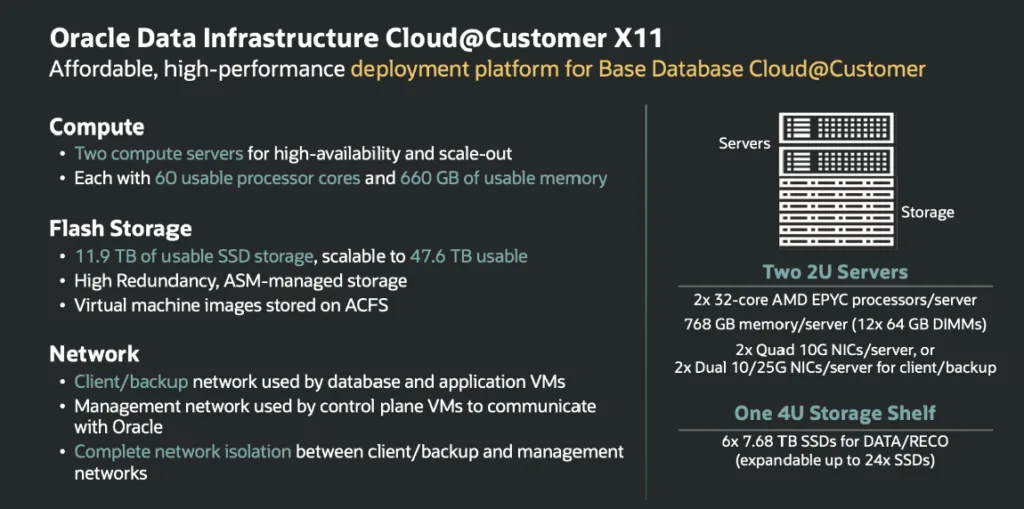
The system installs into a customer’s existing data center rack space and is managed remotely by Oracle Cloud Operations.
- Compute: two servers, each with 60 usable x86 processor cores and 660 GB of usable memory, running Oracle AI Database 26ai or Oracle Database 19c in Enterprise Edition or Standard Edition.
- Storage: shared all-flash capacity starts at 11.6 TB usable and can be expanded online to 47.2 TB; Oracle states that the storage is triple-mirrored across separate SSDs so that a single drive failure does not interrupt availability.
- Networking: 10/25 Gigabit Ethernet for client connections and backup traffic.
- High availability and disaster recovery: databases can run on a single server or span both servers to provide resilience against planned maintenance and unplanned outages. Oracle Real Application Clusters (RAC) is configured automatically by the Base Database service rather than manually. Oracle Data Guard and Active Data Guard provide disaster recovery, with pre-sync checks that screen for ransomware before replicating a record. Zero Data Loss Recovery Appliance (ZDLRA) adds further data protection, consistent with Oracle’s Maximum Availability Architecture (MAA) practices.
- AI stack: Oracle AI Vector Search embeds vector capabilities directly in the database for semantic search and retrieval-augmented generation pipelines. Oracle AI Database Private Agent Factory is a no-code agent-building tool that runs in a container. Oracle Private AI Services Container supports private LLM inference and bulk vector embedding behind the customer’s firewall, separate from third-party AI services.
- Commercial model: pricing follows a pay-as-you-go, consumption-based subscription with online compute scaling, an approach intended to avoid licensing for peak capacity that sits idle, as is common with traditional on-premises systems. Oracle has not published list pricing for the offering.
- Co-located workloads: customers can run application virtual machines on the same infrastructure as the database, reducing footprint and latency for applications that need to be close to their data source.
Analysis
Base Database Cloud@Customer extends Oracle’s Cloud@Customer strategy from the enterprise core into distributed and departmental environments, a segment for which Exadata Cloud@Customer was not built to serve economically.
It reinforces Oracle’s broader argument that AI capabilities belong inside the database rather than in a separate AI or vector data store, and that a single operational model should span from headquarters to remote sites:
- The offering pairs with Exadata Cloud@Customer to give Oracle two pricing and scaling points within the same cloud operating model, which Oracle describes as bringing private AI for data to any customer location.
- Oracle’s positioning depends on customers valuing architectural consistency across sites more than selecting the lowest-cost infrastructure available at each location, a preference that will not hold for every organization.
- The strategy assumes continued customer commitment to Oracle Database licensing. It fits existing Oracle shops modernizing distributed sites better than organizations evaluating database platforms without an existing relationship.
Practitioner Impact
For IT teams operating outside the core data center, particularly those running regional offices, manufacturing sites, or smaller business units, Base Database Cloud@Customer offers a path to Oracle’s cloud operating model without deploying Exadata-class infrastructure.
Because Oracle Cloud Operations manages patching, monitoring, and the underlying infrastructure, local IT staff carry less of the day-to-day database administration burden associated with an on-premises RAC deployment.
Adoption still requires customers to provision rack space, power, and networking on-site, and to plan for the installation and ongoing operation of an Oracle-managed appliance inside facilities that have not historically hosted engineered systems.
Beyond these benefits:
- Organizations already licensed for Oracle Database Enterprise or Standard Edition, particularly those running Oracle Database 19c, receive a defined upgrade and consolidation path to Oracle AI Database 26ai without a full data center refresh.
- Automated RAC deployment removes a common source of on-premises complexity.
- Consumption-based licensing can lower costs for workloads with variable demand. Organizations should model utilization carefully, since actual savings relative to traditional on-premises licensing will depend on how steady the workload is.
- Running AI agents and vector search on the same system as the database simplifies the architecture but also concentrates more workload types onto a single piece of shared infrastructure, raising the stakes of capacity planning.
Competitive Landscape
Base Database Cloud@Customer competes on two fronts: hyperscaler on-premises and edge offerings that bring a cloud operating model to customer sites, and traditional approaches to running enterprise databases on generic on-premises hardware.
The table below summarizes how the leading alternatives compare.
| Alternative | Model | How It Compares to Base Database Cloud@Customer |
| AWS Outposts / Azure Local / Google Distributed Cloud | Hyperscaler-managed racks that extend the public cloud control plane on-site | Bring cloud operations to customer locations but stop at the infrastructure layer; none pairs that model with a natively integrated enterprise database and AI agent stack, so customers still assemble their own database and vector tooling on top. |
| Generic on-premises Oracle Database (Dell, HPE, Cisco hardware) | Traditional Oracle Database licensing on customer-managed, non-engineered servers | Familiar and hardware-flexible, but lacks automated RAC deployment, Oracle-managed lifecycle operations, and consumption-based pricing. |
| Microsoft SQL Server with Azure Arc-enabled data services | Hybrid management layer over SQL Server on customer or third-party hardware | Comparable hybrid management and data-residency story, but weaker native vector and AI-agent integration and no dedicated engineered appliance. |
| IBM Db2 (on-premises / Db2 Warehouse) | Enterprise RDBMS with hybrid and on-premises deployment options | Mature enterprise database with hybrid flexibility, but lacks Oracle’s engineered-system automation and integrated AI agent tooling. |
| Open-source PostgreSQL distributions (e.g., EDB) | Lower-cost, self-assembled hybrid or edge deployment | Lower licensing cost and greater hardware flexibility, but requires customers to build their own HA, DR, and AI tooling rather than receiving it as a managed bundle. |
Within Oracle’s own portfolio, the more direct comparison is running Oracle Database on generic on-premises servers from Dell, HPE, or Cisco under traditional licensing. Base Database Cloud@Customer’s advantage there is automated lifecycle management and consumption pricing, at the cost of dependence on Oracle-managed hardware and refresh cycles.
Final Thoughts
Base Database Cloud@Customer is a logical extension of Oracle’s Cloud@Customer strategy, applying a model Oracle has already validated with Exadata Cloud@Customer, cloud economics and Oracle-managed operations delivered inside the customer’s own facilities, to a segment of the market the larger system was not built to serve economically.
Oracle’s strongest near-term opportunity lies in the large middle ground of workloads that require cloud-style operations but cannot tolerate the public cloud’s distance, data movement, or jurisdictional constraints. Oracle is uniquely well positioned in that market because it already has database relationships with many of the enterprises most likely to face those constraints.
For organizations already running Oracle Database in regional offices, manufacturing facilities, or other locations where data cannot move to the public cloud, Base Database Cloud@Customer gives Oracle a credible offering that did not exist in its portfolio before this announcement. It’s a strong play.
Overall, Oracle’s smaller hybrid cloud system delivers attractive economics, reliable AI performance, and simple fleet management at scale. This gives Oracle a strategic path to extend its database franchise into the distributed AI era and offers customers a practical alternative to choosing between cloud convenience and control over their data.