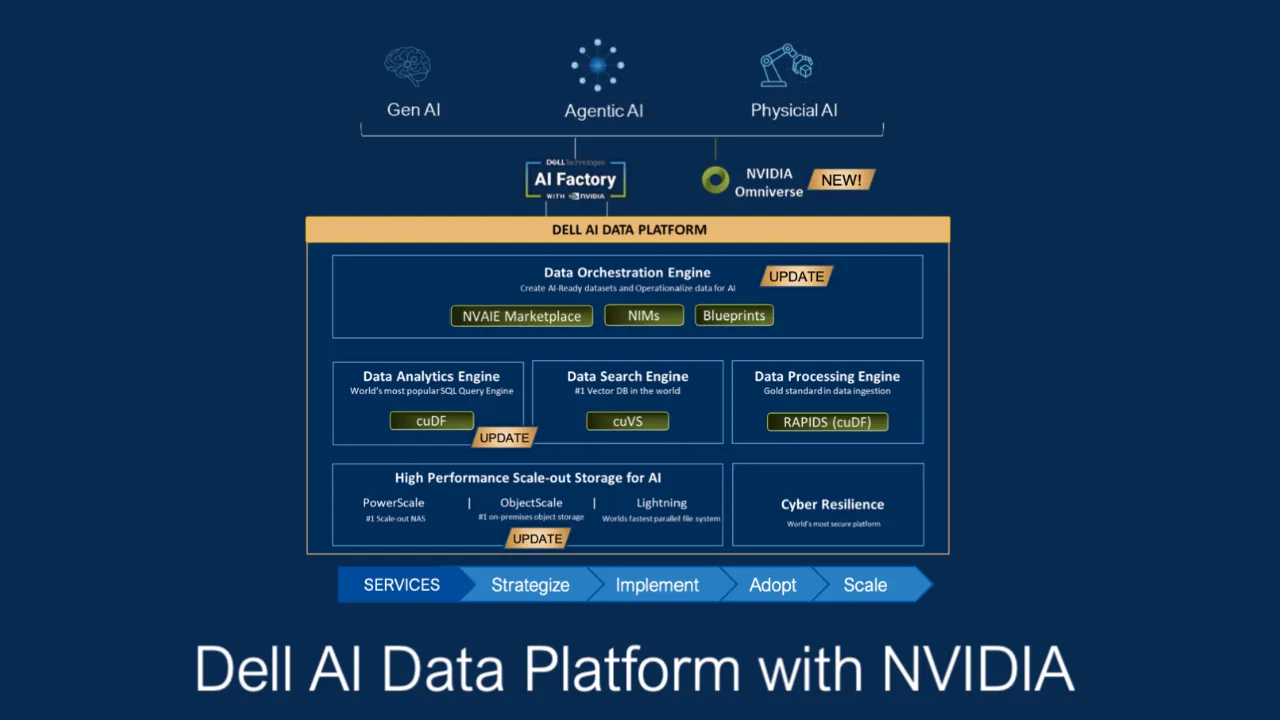
At the recent Dell Technologies World in Las Vegas, Dell announced a broad expansion of its AI Data Platform and storage portfolio, centered on the general availability of the Lightning File System (formerly Project Lightning), the introduction of Exascale Storage as a unified 4-in-1 rack architecture, the refreshed ObjectScale X7700 appliance, and enhancements to the Dell AI Data Platform’s orchestration, analytics, and search layers.
The announcements arrive just as Dell needs them most. Dell’s AI server business has grown dramatically, its AI-related storage has been less robust (this is not a Dell-specific observation — the entire sector has struggled to find AI tailwinds).
Dell’s AI-optimized server revenue reached $9.0 billion in Q4 FY2026, a 342% year-over-year increase. The company guided to $50 billion in AI-optimized server revenue for FY2027. That growth has been anchored in neocloud, sovereign AI, and large enterprise deployments.
Storage, by contrast, grew only 2% year-over-year in Q4 FY2026 to $4.8 billion, a gap that Dell’s DTW announcements hope to address. The AI Data Platform and Lightning File System are Dell’s response to the reality that GPU clusters are only as useful as the storage feeding them.
Overall, Dell is assembling a vertically integrated on-premises AI stack, bringing together compute, networking, storage, data platform, and software ecosystem at a scale no other infrastructure vendor currently matches end-to-end.
Announcement Details
Dell’s announcements span four interconnected areas: the Lightning File System, Exascale Storage, ObjectScale’s AI certification and capacity updates, and enhancements to the AI Data Platform layer.
Each addresses a different tier of the AI storage stack, ranging from raw throughput for training workloads to data orchestration for agentic pipelines.
Lightning File System
Project Lightning, first previewed at Dell Tech World 2024, is now the Dell Lightning File System, a production-grade parallel file system built on PowerScale’s OneFS operating system.
The transition from project to product is a significant milestone, as Dell enters the parallel file system market, which has historically been dominated by Luster-based solutions and IBM Spectrum Scale, and, more recently, by WEKA and BeeGFS.
Key attributes of the Lightning File System include:
- Container-based parallel architecture: designed to disaggregate inference storage and provide extended context memory for long-running autonomous agents.
- Parallel NFS (pNFS) support on OneFS: enabling concurrent multi-client access without the serialization constraints of traditional NAS.
- NVIDIA Dynamo Integration: this includes inference acceleration and NVIDIA CMX (context memory storage platform) for offloading the KV cache from GPU memory to shared high-speed network storage.
Exascale Storage
Dell’s Exascale Storage, introduced at DTW 2026, extends the prior 3-in-1 concept (PowerScale, ObjectScale, Lightning) to a 4-in-1 unified rack architecture by adding PowerFlex block storage. The resulting platform supports file (PowerScale and Lightning), object (ObjectScale), and block (PowerFlex) storage from a common hardware platform built on PowerEdge servers:
- Targeted specifically at high-frequency trading and neocloud environments.
- Read performance of up to 6 TB/second per rack, supported by NVIDIA CX-8 and CX-9 SuperNICs, with planned network connectivity up to 800GbE.
- NVIDIA CMX KV cache offload integration spans all three storage engines (PowerScale, ObjectScale, Lightning), enabling inference acceleration across the full platform.
- Exascale Storage for Dell PowerRack will be available in the second half of 2026; the full Exascale with PowerFlex addition is targeted for the first half of 2027.
ObjectScale X7700
Dell refreshed its object storage platform with the ObjectScale X7700 appliance, delivering a 45% increase in storage capacity compared with the prior-generation ECS 5000.
Key updates include:
- 245 TB all-flash drives support in future configurations, which Dell claims will more than triple flash density compared with current maximums.
- Flexible compute-to-storage scaling that addresses the common limitation of fixed-ratio appliance architectures.
- NVIDIA Certified Storage validation targeted for Q2 2026, enabling ObjectScale to be deployed within certified NVIDIA AI reference architectures.
- Integration with NVIDIA Omniverse is now available, connecting enterprise object data stores directly to the digital twin and physical AI workflows.
- S3 over RDMA support reduces latency for object access in GPU-dense environments.
PowerStore Elite
Dell PowerStore Elite is Dell’s intelligent, open storage platform that integrates AI-driven software, next-generation hardware, and non-disruptive modernization. The platform:
- Triples performanceand densitycompared to prior generations
- Supports up to 5.8 petabytes of effective capacity in a single 3U appliance
- 6:1 data reduction guarantee
- Dell AIOps provides fleetwide predictive insight and automation
- Dell Cyber Detect is a new integrated offering that extends AI-powered ransomware detection directly into Dell PowerStore.
AI Data Platform Enhancements
Dell’s AI Data Platform is a 4-layer software architecture, co-developed with NVIDIA, that sits above the storage engines to provide the data services AI workloads require beyond raw I/O. The layers are data orchestration, data analytics, data search, and storage engines.
The latest updates across these layers include:
- Data Orchestration: Enhanced capabilities to index “billions” of unstructured files and integrate them into governed AI pipelines; Q2 2026 availability for orchestration and search advancements.
- Data Analytics Engine: Starburst-powered, GPU-accelerated SQL analytics; an agentic layer for the Data Analytics Engine was made available in February 2026; full acceleration by NVIDIA Blackwell and NVIDIA Vera is targeted for Q1 2027.
- Data Search Engine: Vector indexing with NVIDIA cuVS integration, enabling semantic search across unstructured enterprise data stores; targeted for availability in the first half of 2026.
- Palantir Ontology integration: Palantir‘s data ontology layer will be deployed on ObjectScale and PowerFlex to connect enterprise data sources and automate business workflows using AI models on the Dell AI Factory.
- MCP Server for Data Analytics Engine: Available since February 2026, enabling agentic AI clients to query the analytics layer through the Model Context Protocol.
Analysis
Dell’s storage and AI data platform announcements are an effort to close the revenue gap between its server and storage businesses by making storage an inseparable component of the AI Factory.
The idea that AI execution fails not because of a lack of compute, but rather because of a lack of storage performance and data pipeline maturity, is accurate. This will resonate with enterprises that have observed GPU utilization drop when training data cannot be delivered fast enough.
Several dynamics are worth noting:
- Tier-2 Cloud Market: Dell’s explicit targeting of neocloud environments with Exascale Storage is a strategic expansion beyond its traditional enterprise IT customer base. The neocloud segment (Tier 2 AI cloud providers such as CoreWeave and Nebius) has been the primary driver of Dell’s AI server growth. Extending that relationship into storage is a logical upsell path.
- Anti-Cloud Message: The anti-cloud positioning evident in the DTW compute announcements extends to storage. Dell’s on-premises AI data platform competes directly with cloud-native data services from AWS, Azure, and Google Cloud. The sovereignty and cost-predictability arguments Dell makes for on-premises AI compute apply equally to data management.
- Partner-centric Approach: Dell’s partner-first approach, including Starburst for analytics, Elastic for search, NVIDIA for acceleration, Palantir for ontology, creates breadth. Dell owns the infrastructure layer; the software stack is a coalition rather than a monolithic platform, giving Dell tremendous flexibility in evolving along with the market.
Training vs. Inference
Dell’s storage and compute portfolio covers both sides of the AI workload divide, with the DTW announcements revealing different strategic emphases for each:
For training workloads, Dell’s bet is on high-throughput parallel storage at scale. The Lightning File System, Exascale’s 6 TB/s per-rack throughput, and the NVIDIA Dynamo integration are all optimized for the data-intensive, sequential-read patterns required for large-model training.
ObjectScale X7700’s capacity expansion and the AI Data Platform’s orchestration layer address the upstream problem of massive unstructured data estates, where getting that data into a form that training pipelines can consume is as much a bottleneck as raw storage bandwidth.
Dell is building a training infrastructure stack that competes directly with cloud-based training environments, making on-premises training economically viable for enterprises at scale.
For inference workloads, the emphasis shifts to disaggregation and cost efficiency. The KV cache offload capability, enabled by NVIDIA CMX integration across PowerScale, ObjectScale, and Lightning, relieves the GPU of the context storage burden during long-running inference.
The Deskside Agentic AI systems address the opposite end of the inference spectrum, where local, low-latency inference keeps sensitive data entirely off the network infrastructure.
The logic is that inference workloads will be distributed across a much wider range of deployment tiers than training workloads, spanning from data center to edge, and Dell’s portfolio spans that full range.
The AI Data Platform’s agentic layer, including the MCP Server for the Data Analytics Engine, extends this inference infrastructure into the data management layer, enabling AI agents to query and act on enterprise data stores in real time.
Competitive Landscape
The AI storage market has fragmented into vendors with distinct philosophies. Dell now competes across all segments of this market, including parallel file, object, block, and data platform. The company, however, faces differentiated competition at each layer:
| Capability | Dell | NetApp | VAST Data | Everpure (Pure Storage) | HPE | Lenovo |
| AI File / Parallel Perf. | Lightning PFS; pNFS on OneFS; 97% claimed NW utilization | ONTAP AI + NFS; AFF A-series; NVIDIA DGX-ready | VAST Universal Storage; unified NFS/S3/SMB namespace | FlashBlade//EXA; SPEC Storage AI_Image benchmark leader; Evergreen//One SaaS model | HPE Cray ClusterStor | Lenovo DSS-G |
| Object Storage | ObjectScale X7700; S3/RDMA; NVIDIA Certified (Q2 2026) | StorageGRID; cloud-integrated; AWS/Azure/GCP native | VAST — file/object in unified namespace; no separate object tier | FlashBlade//S; object and file; Portworx for cloud-native | HPE Alletra dHCI | Lenovo ThinkSystem DE |
| AI / Data Platform | Dell AI Data Platform: 4-layer (Orch., Analytics, Search, Storage); partner-assembled | NetApp AI Data Engine: ONTAP-native; storage-layer ransomware + exfiltration detection | VAST DataSpace + DataStore: fully integrated platform incl. database and app runtime | Everpure Platform + 1touch (May 2026): data discovery, classification, contextual intelligence | Partner-reliant; no native AI data platform | Partner-reliant; no native AI data platform |
| Hyperscaler Tie-in | On-prem sovereign; no native cloud embed | Native in AWS, Azure, GCP (ONTAP Cloud); strongest hybrid story | Primarily on-prem; cloud partnerships evolving | Pure Fusion hybrid/multi-cloud; Pure1 AIOps; Evergreen//One consumption model | On-prem focus; limited cloud-native | On-prem focus; limited cloud-native |
| Neocloud Footprint | Exascale explicitly targeted at neoclouds; Lightning inference attach | Growing; NVIDIA DGX-ready; less neocloud-native | Strong; purpose-built GPU cluster attach; neocloud heritage | FlashBlade//EXA positioned for AI training clusters; growing neocloud footprint | Minimal neocloud footprint | Minimal neocloud footprint |
| NVIDIA Integration | CMX, Dynamo, Omniverse, DGX-ready; NVIDIA AI Data Platform co-developed | NVIDIA AI Data Platform certified; ONTAP integration | NVIDIA DGX reference architecture; early CMX work | NVIDIA AI Data Platform co-engineered (Data Stream); FlashBlade NVIDIA Certified | NVIDIA partnership; less ecosystem depth | NVIDIA partnership; less ecosystem depth |
NetApp’s Intelligent Data Infrastructure is the most direct enterprise analog to Dell’s AI Data Platform, operating at a similar scale, serving similar customer profiles, and sharing a similar depth of NVIDIA partnership.
The core competitive tension is cloud reach versus infrastructure integration: NetApp’s ONTAP Cloud is natively embedded in AWS, Azure, and Google Cloud, giving it hybrid data continuity that Dell’s on-premises-first architecture cannot match.
Dell’s counter is full-stack depth. While NetApp sells storage and data management, Dell sells storage, compute, networking, cooling, and services to integrate them.
VAST Data is Dell’s strongest competitor in the tier-2 cloud market. VAST competes well in the narrower, but critical segment of AI-native infrastructure for GPU-dense environments.
Its Universal Storage eliminates the file/object protocol boundary that Dell’s multi-engine Exascale architecture maintains. VAST’s integrated DataSpace and DataStore platform layers extend from storage into compute-adjacent territory without the seams introduced by Dell’s partner-assembled AI Data Platform.
VAST’s constraint is scope, as the company lacks compute, networking, and enterprise lifecycle services, which are Dell’s strengths. While VAST has several marquee enterprise accounts, most of its AI-related business appears to be in the tier-2 cloud market, where the company holds an enviable incumbent position among leading providers such as Coreweave.
The company, while private, has the resources to protect its neocloud market position. VAST raised about $1B in capital in its most recent funding event.
Everpure most directly threatens Dell’s storage-first enterprise business. Pure’s FlashBlade//EXA holds the leading position on the SPEC Storage AI Image benchmark, and Evergreen//One offers a consumption model that sidesteps the CapEx requirement for purchasing Dell products.
Pure’s recent 1touch acquisition also moves the company into the data intelligence territory that Dell occupies through its assembled partners.
HPE and Lenovo are less competitive in the AI storage and data platform markets than NetApp, VAST, or Everpure, but neither is irrelevant. HPE’s Cray ClusterStor has HPC heritage that lends it credibility in compute-adjacent storage environments, and the upcoming HPE Discover event in June will clarify whether HPE is building a cohesive AI data platform. Lenovo competes primarily on price in enterprise storage and has not articulated an AI data platform strategy.
Dell holds a commanding position against both.
Final Thoughts
Dell’s storage and AI data platform announcements at Dell Technologies World is the most substantive expansion of its storage portfolio’s AI relevance since the company introduced PowerScale.
The Lightning File System’s transition from project to product, the Exascale rack’s 4-in-1 architecture, and the AI Data Platform’s orchestration and search enhancements address real gaps that have kept Dell’s storage business from participating in the AI infrastructure demand cycle in proportion to its market share.
The roadmap is credible, the NVIDIA integration is deep, and the on-premises sovereignty argument resonates with the enterprise and government customer base Dell has cultivated for decades.
The neocloud dimension introduces a forward growth vector that Dell’s traditional storage narrative lacked. Dell’s AI server business demonstrates that it can win neocloud customers at scale; the company carried a $43 billion AI server backlog entering FY2027 show that Dell has moved well beyond its enterprise IT origins in the compute market.
Exascale Storage, specifically named by Dell as a solution for neocloud environments, provides a basis to expand storage and data platform revenue within the same customer base already running Dell PowerEdge XE servers for AI training.
The conversion odds are favorable, as neoclouds deploying Dell compute for AI training workloads are the natural first buyers of Lightning and Exascale storage, creating a cross-sell path with lower acquisition cost than new customer development. Dell arrives with a strong cross-portfolio story, backed by its global services and support footprint and strong partner ecosystem.
If Dell’s updated storage portfolio converts to customer deployments at the pace the AI server business has demonstrated, Dell’s storage business has a credible path to growth rates that finally match its compute business. For the first time, Dell’s storage portfolio puts that within reach.