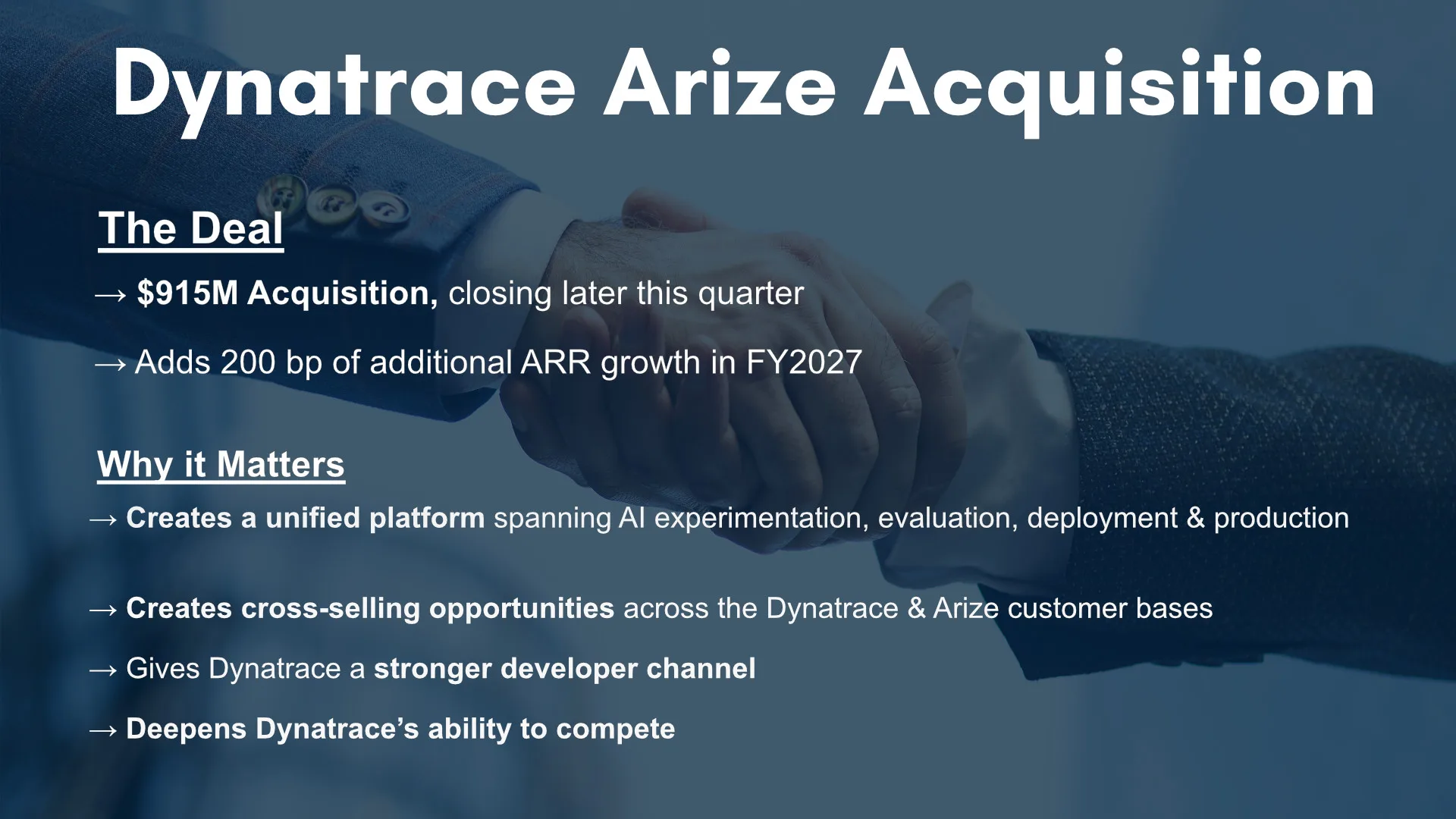
Observability leader Dynatrace announced its intent to acquire Arize, a venture-backed company specializing in AI observability and large language model evaluation, for $915 million. This is Dynatrace’s third acquisition of 2026.
Arize provides a platform for evaluating and monitoring the behavior of large language models, AI agents, and machine learning systems in production, addressing issues such as hallucination detection, output quality measurement, and behavioral drift that fall outside the scope of conventional application performance monitoring.
Dynatrace built its business on infrastructure and application observability for traditional software stacks and has extended the platform to support cloud-native and AI workloads. The acquisition connects Dynatrace’s production telemetry with Arize’s model- and agent-level evaluation capabilities. Arize also gains access to Dynatrace’s enterprise customer base, the Grail data platform, and the global go-to-market organization.
The transaction is expected to close later this quarter or early in Dynatrace’s third fiscal quarter, subject to regulatory review and customary closing conditions.
Who Is Arize?
Arize AI was founded in 2020 by chief executive officer Jason Lopatecki and chief product officer Aparna Dhinakaran. The company was created to give AI teams a systematic way to determine whether models and agents are performing correctly.
The company built its business around the idea that AI development differs fundamentally from traditional software engineering: model behavior can degrade silently in production, even when infrastructure metrics appear healthy. Evaluating that behavior requires tooling designed for probabilistic systems.
Arize’s product line spans three components:
- Arize AX: An enterprise evaluation and observability platform that supports generative AI, autonomous agents, traditional machine learning, and computer vision workloads.
- Phoenix: An open-source AI observability and performance-tracing project released in 2023 has surpassed 2 million monthly downloads, providing Arize with a substantial open-source distribution channel and developer mind share independent of its commercial platform.
- Arize AI Copilot: An AI assistant with more than 50 built-in skills layered on the platform to help engineers debug and evaluate AI systems directly.
In February 2025, Arize raised a $70 million Series C round, led by Adams Street Partners. Participants included Microsoft‘s venture arm, M12; Sinewave Ventures; OMERS Ventures; Industry Ventures; Archerman Capital; Datadog; Foundation Capital; Battery Ventures; TCV; and Swift VC.
Datadog’s participation is notable because it competes directly with Dynatrace in the broader observability market. Investor access to Arize will end upon the acquisition’s close. Arize has not disclosed exact paid-customer counts or annual recurring revenue figures.
Strategic Fit & Rationale
“AI observability is — absolutely is a $10 billion incremental sector or category to the $80 billion or so overall observability space is going to be phenomenal, and it’s growing at 40%, 50%. So this is going to be a new area for us to monetize that is mission-critical to the evolution of the observability market…” – Dynatrace CEO Rick McConnell, KeyBanc Leadership Technology Forum, August 10, 2026
Dynatrace has historically pursued a strategy of layering new, often open-standards-oriented capabilities onto its core observability platform through acquisition rather than internal development alone, including its recent acquisitions of BindPlane for OpenTelemetry collection and DevCycle for feature management.
The Arize acquisition continues the pattern into AI evaluation, a category Dynatrace has not developed internally to a comparable depth.
The acquisition closes the gap between two observability layers that have largely evolved in parallel.
- Dynatrace’s core platform, built around full-stack infrastructure and application monitoring and augmented by its Davis AI causal engine, tracks system health, performance, and root cause across cloud-native environments.
- Arize’s platform evaluates whether the AI models and agents operating in those environments produce correct, safe, and consistent outputs, a question infrastructure telemetry alone cannot answer.
Combining these capabilities enables Dynatrace to trace an issue from a business outcome or user-facing failure, using application performance data, to the specific model or agent decision that caused it, rather than requiring customers to manually correlate two disconnected data sets.
Dynatrace expects the acquisition to be approximately 200 basis points accretive to annual recurring revenue growth in fiscal 2027, while diluting non-GAAP operating margin by about 175 basis points in the same period. Margin expansion is expected to resume in fiscal 2028 and beyond.
Analysis
Prior to the acquisition, Dynatrace’s AI-related capabilities focused on using its own Davis AI engine to help customers operate infrastructure and applications, a different problem from evaluating whether a customer’s AI systems are behaving correctly.
While Dynatrace provides visibility into AI workload behavior, its native capabilities are limited when assessing whether the model or agent driving that workload was hallucinating, producing biased outputs, or drifting from expected behavior over time. Arize closes that gap.
Arize brings model- and agent-level evaluation techniques, a tracing framework purpose-built for LLM and agent behavior through Phoenix, and an engineering team with several years of specialization in a problem space that Dynatrace would otherwise have needed to build internally.
It also brings an open-source distribution channel that Dynatrace’s traditional enterprise, sales-led motion lacks on its own, which will extend Dynatrace’s reach into developer teams building AI applications beyond its existing customer base.
The acquisition leaves several challenges unresolved. Model evaluation quality depends heavily on domain-specific rubrics and continuous tuning, and Arize’s techniques must generalize across the industries and use cases in Dynatrace’s broader enterprise base.
Dynatrace will also need to decide how deeply to integrate Arize’s evaluation data model into Grail. A shallow integration would leave customers with connected products that remain functionally separate and would fall short of the evaluation-to-operations pipeline described in the strategic rationale.
Practitioner Impact
The combined Dynatrace/Arize speaks to multiple audiences, each with varying degrees of impact:
- IT practitioners: The acquisition provides a single platform spanning AI development, evaluation, and production operations. Many teams currently assemble those capabilities from separate LLM evaluation tools and infrastructure-monitoring dashboards. Dynatrace’s acquisition of Arize changes that equation.
- Site reliability and platform engineering teams that already rely on Dynatrace for application performance monitoring: Gain visibility into model and agent behavior without adopting a second vendor.
- Data science and machine learning engineering teams that have adopted Arize AX or the open-source Phoenix tracing library: Gain access to Dynatrace’s broader telemetry data and its Grail data lakehouse, enabling more comprehensive root-cause analysis when an AI-driven failure has downstream infrastructure or business impacts.
Integration carries some execution risk, however:
- Arize’s platform was built independently, with its own data model, user experience, and open-source community around Phoenix. Folding it into Dynatrace’s platform without disrupting that community or degrading the standalone product will require sustained engineering investment across multiple product cycles.
- Enterprises already running Arize AX as a standalone tool will need clarity on licensing, pricing, and roadmap continuity during the transition.
- Teams currently combining Arize with a competing infrastructure observability vendor must decide whether to consolidate on Dynatrace or keep Arize as an independent, multi-vendor evaluation layer.
Competitive Landscape
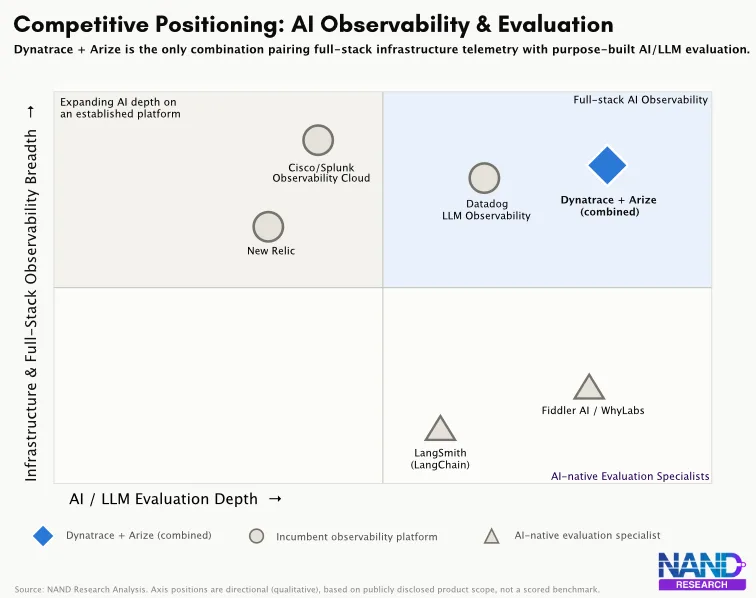
Dynatrace operates in a competitive field where most large observability vendors have already added some form of LLM or agent monitoring, alongside AI-native specialists that compete directly with Arize:
- Datadog has built out LLM Observability with capabilities for agentic AI monitoring. A notable wrinkle of this deal is that Datadog itself was an investor in Arize’s most recent funding round, giving it visibility into Arize’s technology and roadmap that will end once the acquisition closes.
- Splunk, now under Cisco, has added AI agent and AI infrastructure monitoring to Splunk Observability Cloud, powered by Cisco’s networking and security data.
- New Relic offers AI monitoring capabilities within its broader platform, with less specialization in LLM evaluation.
Among AI-native specialists, Fiddler AI and WhyLabs compete on the depth of model evaluation and monitoring, while LangSmith, built by LangChain, has strong developer adoption among teams already building on the LangChain framework.
| Alternative | Model / Approach | Releative to Combined Dynatrace-Arize Platform |
| Datadog LLM Observability | Native module inside Datadog’s broader observability suite; Datadog was also a minority investor in Arize’s Series C round | Comparable breadth of agentic monitoring features and a larger existing enterprise install base, but no acquisition of comparable AI evaluation depth; loses its investor visibility into Arize once the deal closes |
| Splunk Observability Cloud (Cisco) | AI agent and AI infrastructure monitoring built into Cisco’s security and networking data | Strong infrastructure and network-layer context Dynatrace lacks, but its AI evaluation capability is newer and less specialized than Arize’s purpose-built platform |
| New Relic | AI monitoring features layered onto its unified observability platform | Platform reach comparable to Dynatrace’s, but comparatively limited depth in LLM-specific evaluation and hallucination detection |
| Fiddler AI / WhyLabs | Independent, AI-native model monitoring and evaluation platforms | Comparable or deeper specialization in model evaluation for some use cases, but lack Dynatrace’s infrastructure and APM breadth, leaving customers to integrate two vendors |
| LangSmith (LangChain) | Framework-native tracing and evaluation tied closely to LangChain-built applications | Strong adoption among LangChain developers specifically, but narrower framework scope than Arize’s framework-independent approach and no infrastructure observability layer |
Dynatrace’s clearest advantage (post-acquisition) is its ability to connect an AI evaluation finding with infrastructure behavior and business impact. AI-native specialists lack Dynatrace’s full-stack telemetry, while incumbent observability vendors generally offer less depth in model and agent evaluation.
Near-term sales execution is an area to watch. AI-native specialists retain framework flexibility and lower switching costs, whereas Datadog and Splunk can point to agent-monitoring features already delivered as native platform capabilities. Dynatrace must sell the combined roadmap while integration is still underway.
Final Thoughts
As generative AI and autonomous agents move from pilot projects into systems that make consequential decisions, understanding why an agent produced a particular output becomes as operationally important as understanding why a server went down, and today’s market forces customers to stitch that picture together across separate tools.
The acquisition of Arize gives Dynatrace this capability. Arize brings genuine technical depth, an established open-source community around Phoenix, and Fortune 500 customer relationships, reducing the more common risks associated with this type of acquisition.
The central questions concern execution and market timing. Dynatrace must integrate a company with a distinct product philosophy and developer community, reach AI and data science buying centers beyond its traditional sales relationships, and manage the near-term margin dilution already included in its guidance.
Given Dynatrace’s history of successfully acquiring and integrating smaller, specialized observability vendors gives us confidence that this won’t be a challenge for the company.
The caution is this: Datadog’s prior investment in Arize and Dynatrace’s own overlapping LLM Observability product are a reminder that the largest infrastructure observability vendors are converging on the same thesis at roughly the same time, which will compress the first-mover advantage this deal delivers.
For enterprises evaluating AI observability, however, the acquisition shows that the category is consolidating faster than the underlying tooling is maturing, and that vendor selections made this year are likely to be revisited within eighteen to twenty-four months as Dynatrace, Datadog, Splunk, and the remaining AI-native specialists determine which will own the connective tissue between AI evaluation and production observability.
The bottom line is that, with Arize, Dynatrace becomes a stronger competitor in an increasingly crowded observability market by combining full-stack operational telemetry with specialized AI evaluation, an established developer ecosystem, and access to enterprise AI and data science teams.
The acquisition gives Dynatrace greater technical depth across the AI lifecycle and a broader path into the organizations shaping enterprise AI strategy.
As companies move generative AI and autonomous agents into high-stakes production workflows, Dynatrace is better positioned to compete for the platforms, budgets, and customer relationships that will define the next phase of enterprise observability.